Dragon Magazine #27: Board Games and the Philosopher Stone

Dragon #27The cover of dragon #27 depicts a knight in shining armor readying an attack , lance in his hand, sitting on his horse. Good example of what Editor Tim Kask admits in this issue’s editorial, that some of the covers so far were, let’s say mediocre. And why’s he saying that? Well, #27 is another birthday issue and Mr. Kask takes the opportunity to look back on what The Dragon did well and what it did not so well. He’s also looking forward to what is yet to come, though most things he talks about come down to ‚more of the same, but better‘.

It’s Tim Kask again who reviews SPI’s The Battle of Agincourt, one of those battle simulation games I ‚ve not understood why to play them til today. As much as I’m a history afficionado (and even have studied it for some years), I’ve never had the least interest to play such simulations especially when the result of the game is enforced to ensure historical accurateness. According to the words of Tim Kask, Agincourt is such a game, where the English army will win every time as long as you’re playing by the book. This is like me playing a game of chess against Magnus Carlsen . Ok, but enough from me, Mr. Kask, while critizising some minor points, generally likes this game very much, so different tastes and all.

The game’s designer, James Dunnigan, follows up with some Designer Notes regarding this game. According to him, this game is more than just that, it is also a historical study regarding medieval strategies, tactics and battle formations. This also explains certain design decisions he made regarding leadership and morale factors. Still not my cup of tea, but at least I can see why someone might like activities like this.

The third Agincourt article by Steve Alvin is easily the most interesting of those three. The Political and Military Effects of Agincourt on the Hundred Years War describes the political situation and events in England and France leading to the Battle of Agincourt as well as the consequences and developments after this decisive English victory. I generally like those articles, because when you’re building your own world, they can be really helpful in inspiring the timeline of your setting and the relations between different countries.

Elementals and the Philosopher Stone by Jeff Swycaffer is the first D&D related article of this issue. Jeff presents a new system of 12 elements as well as 12 elementals. Interestingly enough, those 12 elements include Good and Evil (with their elementals being angels and demons), so there is a bit of alignment involved. Apart from those elementals already published in official products, each gets a short description of their looks and their special powers , while a table with game values makes them ready to be used in play. The article also contains instructions to build your own philosopher’s stone as an irregular polyhedron which can be used as a die. Which he uses to add simple rules for a more or less funny Question-Answer game. I think this article is mostly interesting for the fact that he seem to have influenced how D&D’s Inner Planes would be presented in later editions.

In this issue’s Sorcerer’s Scroll, guest author Bob Bledsaw gives his thoughts on what Judges Guild has done for the success of D&D as a whole. As I was a bit late to the party, I’ve never used anything by JG but I’ve heard more good than bad about it. And at the least, this article gives a nice overwiev about the product list, Judges Guild created over the years. Next is a short report on 1979’s Cangames, a canadian convention Gary Gygax visited. And he has a lot of praise for it.

Out on a Limb returns with a very longish answer to accusations against Ralph Bakshi in a former issue. And a very short answer by the editor himself to a really harsh attack against the critique formulated regarding the Soldier of Fortune magazine.

Next is a short articly by Gary Jordan about the use of a Tesseract as an Traveller Artifact, that can be used as additional storage room or as an escape pod in case of an emergency situation. What follows is a one-page comic by Tom Wham about „The Voyages of Exploration Ship Znutar”, which is mainly an advertisment for the game to follow up in the next issue. After that, it’s again Gary Jordan’s turn, this time with a short system for Star System Generation in the Traveller game.

Next article is the Designers‘ notes on Glenn and Kenneth Rahman’s game Divine Rights. Again, board game, so not too much love from me, but Minaria, the background setting for this game was quite awesome and I really enjoyed the article series Minarian Legends that would be later published in the pages of Dragon, but we’ll come back to that.

A quick look at Dwarves by Lance Harrop is a short summary of how the dwarven army might be organised. It comes with a chart for that organization which I guess could easily serve to form a dwarven army in any kind of system that has some rules for mass combat.

Aaaaand another set of Designers‘ notes, this time for The Emerald Tablet, which is a set of rules for miniature combat within a fantasy setting, that seems to be mainly remarkable for how it includes magic into the combat system though it seems as if this game never got much traction.

The second issue of Lawrence Schick’s and Tom Moldvay’s series Giants in the Earth presents Alan Garner’s Durathror, Fritz Leiber’s Fafhrd and the Gray Mouser and Edgar Rice Burrough’s John Carter of Mars. Never felt much use for characters from other settings in any of my games, but still like the series for the shout-out it gives to several more or less famous fantasy authors.

Next is a review about Philmar’s The english Civil War another board game, that seemed, according to Tim Kask, to suffer under a very shoddy presentation. It follows a game variant for the Imperium board game by Roberto Camino and a review by D.Minch for the air warfare game MiG Killers (what a name).

I generally like Jerome Arkenberg’s Mythos of… series, but with Mythos of Africa, I think that he crammed too much stuff into one article. I’m by no way an expert for african myths and folklore, but I know enough about the variety of the african people to be fairly sure that you‘ can’t do this topic justice on two pages. Now Arkenberg doesn’t pretend otherwise, but still I think that there is a lot of potential wasted by putting all of this in one pantheon.

Dragon’s Bestiary; The Horast by Mary Lynn Skirvin presents us with a fairly unimpressing monster that is also called the whipper beast for the whip-like tail it possesses and that it can use as a weapon in combat.

In the comics section we have another hilarious issue of Fineous Fingers, in which his friends continue their escape from the evil wizard’s castle. And last but not least, Gary Gygax presents us another issue of the Bazaar of the Bizzare, this time with the Bag of Wind, which comes in 5 variants named after the four winds of greek mythology and their keeper Aeolus. This item should be well-known to everyone who has read Homer’s Odyssey.

Wow, this took me along time. I hope you won’t have to wait for the next installment of my review series as long as for this one.
[Review]Weekly Wonders-Drunkard’s Grimoire

Weekly Wonders – Drunkard’s Grimoire by Necromancers of the Northwest is a collection of 12 alcohol-based spells presented in the artistic style typical for those product (nice tome-like cover, a few black and white illustration inside the book.) As stated in the introduction, those should serve to extend that theme on spell-casters and is partly inspired by the Cult of Dionysos, while so far, mainly Monks and Barbarians had alcohol-themed archetypes. Also in the introduction is printed a list of official alcohol-based content. It seems not to be complete (a short Google search pointed me at the official combat trait „Accelerated Drinker“), but I still give bonus points for including that, because it is also stated that the part of the spells work in conjunction with those class features and archetypes, so to have this ready as a reference may come in handy. There’s also a hint at another Weekly Wonders Issue (Drunken Feats), that also might work with those spells, but as I don’t have that product (yet), I can’t say if that’s the case.

With two exceptions, the spells are cast at either a living creature or at a drink that has then to be imbibed for the spell’s effect to take place. In those cases, the drink in question can be drunk as part of the spell casting, so the casting time is unaffected by that (same goes for alchemists that might use such a spell). To give an impression, a short description of some of the spells follows:

Beer Goggles: impairs the sight of the drinker, who gains save bonus against gaze attacks, but also becomes more susceptible to diplomacy checks and charm effects.

Blackout: impairs the target’s ability to form memories, so they can’t remember what happened after.

Deadly Tankards: makes tankards into weapons. Also, you won’t spill the content while using them this way.

Valorous Whiskey: Drinker gains cold resistance and a morale bonus on attack rolls saves and some checks.

In the end, if I had one thing to criticize, then that some of the spells would require the GM to work with the player spell-caster (because there’s no use casting a spell on some drinks if the NPCs simply won’t drink them), which might be a con for players who don’t like such dependencies. On the other hand, as the GM, I immediately had some ideas how to use some spells even to introduce the players into a new adventure, so at least to me, they have a positive inspiration factor. And that you can use some of them as buff spells with (rum) flavor is something I really like very much. Mechanically, the levels of the respective spells seem right to me, and I wouldn’t have any problem if one of my players would want to use some of them. So if you like the theme of this product, I think it’s well worth it’s price and grant it full five stars.

If I could turn back time…

Well, originally I wanted to make another post in which I put out some ideas about what to do with the „Abbey of the Crusader Goddess“ in my own setting, but as that could get kinda confusing I think it’s better to talk a bit about the setting itself, especially about where I started with it and where I landed at the moment. Because in fantasy worlds, you sometimes can turn back time and that’s what I did while mulling ideas in my head over and over again.

So where did it started ? It kinda started with this sentence I found in the 3.5 Eberron Campaign setting: If it exists in D&D then it has a place in Eberron. What a bold and impressive statement that was. And given that I was an avid reader of all things D&D at that time and that I tend to get a lot of ideas just by reading things, I immediately thought that it would be awesomely cool to make that statement my own and build a world containing all the ideas I found in the books or magazines I was reading (with the additional caveat that it should all make sense and still feel like a cohesive setting).

From that point I developed the idea of a world created by dragons, shut up from the rest of the universe in a closed demi-plane [insert long cosmological background here]. Dragons would have gone extinct on that world, and as they were the universal bearers of magic, magic would be all but gone as well. Until the barriers between that demi-plane and the surrounding material plane started to dissolve and magic crept back into the world (and with the magic the dragons would return), though that was planned to be the theme of the adventures to be played in that setting. By the way, I think the dragon theme was inspired by Eberron as well, as Tetheril (the setting’s name) was literally the ancient time dragon that created that world.

Now, the reason for the slow dissolution of the plane’s barriers was intended to be a big cataclysmic event that all but destroyed the continent on which the human race had developed. So I developed the idea that in a future age, humans would return to that continent to resettle it, eventually finding out what the mystery behind that cataclysmic event was. I’m not totally sure about the timeline, but I think that at that time, Pathfinder’s Kingmaker AP was published and I thought that hexploration was a good way to introduce players in a setting totally unknown to them. By exploring the continent, they would not only learn about the general setting, but they could also delve into the human race’s history and learn about past events as those started to shape the present and future.

In the meantime I had suffered a severe case of GM burnout and basically stopped doing anything roleplaying-related. I probably would have totally given up on the hobby, if not for Johnn Four, publisher of the Roleplaying tips, who started an adventure workshop in which he let me (and other interested people) take part in his design of an adventure and invited us to develop our own adventure parallel to his. I have to admit that I didn’t succeed with that, but it renewed my interest in the hobby and it brought some new inspiration. And this is where the first time jump comes in. Because when originally I had planned to start with the landing on their old/new home continent, the adventure I had planned for the workshop was intended to be a prelude to that, basically explaining the reason for why the humans wanted to go back to the old continent. (in short: after the cataclysm they had found refuge with the elves that lived on another continent, but because of old enmities they were basically living in a golden cage which is nothing human nature is suited for.)

I didn’t went through with this idea and again, things kept simmering in my stew pot brain, until I got (again) an email by John, in which he announced a second walk-through through his workshop, only that this time, he went from a messageboard to a homepage-based format. I started again, but in the meantime, another idea had formed in my head. And here comes another time jump back to the past.

Because in the meantime, I had found out for myself that one thing that I really don’t like in campaign settings, is that more often than not, that there are big-world-shaking events that you never get to experience first hand because the campaign starts well after those events took place. Think Golarion, where campaign play starts 100 years after the death of the god if humanity, think the Realms‘ Spellplague, that was a major shake-up between the editions, only that 4E started the campaign when it already was over (again, 100 years later). Contrary to that, Eberron really clicked with me because there the campaign started directly in the aftermath of such an event (the destruction of Cyre resulting in the end of the Last War), so the direct consequences of that were point and center of campaign play in that world.

So why not start directly after the destruction of the homestead of humanity (I would have started with it, but that would have meant explaining the mystery around that event) and the rest of humanity finding shelter with the elves. The idea was that the elves would allow the humans to settle an abandoned elven city located on an island before the coast of the elven kingdoms. So I could still have exploration of a new setting, but I could also explore what the loss of their old home and the reliance on what they used to consider an enemy would mean for the human survivors.

And this is basically where I am now. A huge elven city in ruins (think Myth Drannor) to be explored and to be settled by the PCs, maybe finding new allies (and enemies) in the process. That does not mean though that I’ve given up on all those other ideas I had before. In fact, wouldn’t it make for an awesome chronicle of the world of Tetheril, if I could succeed in developing the different parts throughout time and space and make them into a coherent hole?

Guess I’ll better start soon, because I’m only human and my life is finite.

[Review]Abbey of the Crusader Goddess

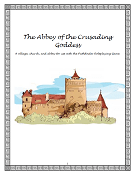
AotCGThe Abbey of the Crusading Goddess by Cian’s Basement Books comes in at 18 pages (1 cover page, 1 page ToC, so it’s basically 16 pages of actual content). Layout is simple, but clear, and the font size might be bigger than in other products but I found that it made reading the product quite easy, and I didn’t feel that it came at the cost of the content.

The product starts with a short description of the history and the location of the abbey. And while it’s described in a very general language, it’s easy to see that the inspiration for that probably came from Paizo’s Mythic AP. Still it’s generic enough that you can use it in any other setting easily. You can even reuse the 5 location hooks, giving a group of PCs a reason to travel there, which I think is a nice idea to have for a location. Then we learn about the local area, especially the village that has been built next to the abbey. There are several shops situated next to the abbey’s walls, and each of those gets a short paragraph including who owns it and what you can get there.

It follows a very detailed description of the five floors of the abbey and after that several statblocks detailing the abbey’s inhabitants, three for the more common members, then two important NPCs running the abbey as leaders. And last, there is a new feat, that grants the benefits of several orisons a number of times per day which is a nice way to grant a PC minor buffs without having the party cleric to cast them.

I haven’t talked about the maps yet. They are very simplistic in an old school kind of way, but also very clear and give you all the information you need and that are expanded on in the relevant test descriptions. Those maps cover everything I just talked about, from the abbey itself to every single floor.

All in all, I liked this product very much as it gives you the basics for such an abbey without adding to much fluff to it. This means that you might need to work a bit while you integrate it in any setting of your choice, but it also means that you won’t have to ignore too much (or anything at all) if you want to use it. It also has a special touch to it in that as written it is an abbey pretty much run and protected by women, but that doesn’t get forced upon the reader and could easily be changed if necessary. Though I like it very much this way.

So I’ll give it 3.5 out of five stars. And as this seems to be the first effort of a new publisher and as such, I think it has been well done, even if it isn’t on par with the more established 3PPs out there, as far as layout, artwork and maps are concerned, I don’t want too be to stingy with my stars so I’ll round up to 4 stars. If you have need of an abbey for your game and don’t mind to put a bit of work to add those fluff colours that integrate this into your setting, I think it’s well worth buying.

My To-Do-List or the list of some of the things I plan to do but so far never did

So again, a long time has gone since my last post, and not only didn’t I post anything, I did also nearly no work on the projects I had planned to do. Which is a shame really, as I’m constantly thinking about them, but I already had a post about my talent to procrastinate. Though I’m also stubborn, so I’m still not willing to let my plans go, especially as in recent days, inspiration struck from several places.

But before I start to work, I’d better collect my different ideas in a single post for future reference. Nothing more than a to-do-list that might help me to plan what to tackle first. I’m not going into specifics here, as I plan to tackle single points in future blog entries.

1. I finally want to realize my own setting, which I already talked about and that I started thinking about around 10 years ago. Ideally, it will have a very sandboxy structure, so that it can be used as is by others in case it gets published, but it might also be the starting point for a very big chronicle with an overarching storyline and a certain endgame in mind. Those ideas might never see the light of day though, so I probably won’t do more than hint at some of them in the actual setting.

2. A campaign arc very much inspired by Paizo’s Kingmaker AP, that should let the PCs explore part of the new setting and might hint at future developments .

3. I also talked about the adventure I started to design for Johnn Four’s Adventure Workshop and that will be the first introduction to my setting. It might also spawn a campaign that highlights an important point in the past of my planned setting, though it uses it’s own mini-setting (same world, other place) that should be easily usable as a stand-alone thing.

4. Another possible campaign arc mostly inspired by the second issue of Kobold Quarterly. Not sure where this will fit in with regards to my setting, could be basically the follow up to one of the campaign arcs mentioned in 2 or 3.

5. And (ain’t I the adventure guy? 😀 ) another adventure that definitely will take place in the new setting (meaning sometimes after the events of #2), that will put some events in motion that will lead to a big climax (which was the original inspiration for my setting.

Apart from all this creative stuff, there are some other things that I’d like to do as well, so Iäll also mention them here.

1. I still plan to re-read the old Dragon Magazine issues (and also the Dungeon ones) and put short reviews/commentaries on this blog.

2. Same goes for reviews of Paizo/Pathfinder 3PP materials (might also include products for other rules systems)

3. I have a certain fondness to do adaptations of adventures in other settings that I love. SO I hope to be able to do a series of articles how to adapt Paizo Adventure Paths (and stuff from other Publishers like the recently announced Rage of Wyrms AP by Legendary Games) for the Realms and Eberron. Oh, and did I mention that I plan to do my own setting? So we might see adaptations for that one as well 🙂

4. Depending on what my setting needs, I might also work at rules modifications, If so, I’ll certainly talk about it here at this blog as well.

5. I sometimes feel the urge to talk about things that are not roleplaying-related, mainly music and politics. I’m still not sure if I should do that here, but I also hesitate to start another blog and those worlds (the music world and the reality) are also two of the worlds I live in so they might actually fit here. We’ll see.

Probably forgot some things. But already this list feels like the reason I do procrastinate so much. Too many ideas to do them all in my lifetime. At least that’s my excuse all too often, though it’s not a good excuse to do nothing at all; so that needs to change.)