 This is something which I should have posted a year ago. I was actually kinda surprised to find out that I hadn’t. SO without further ado:
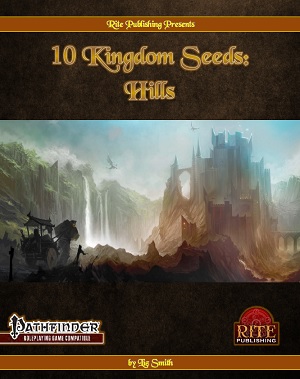
Rite Publishing Presents 10 Kingdom Seeds: Hills by Liz Smith is part of a series providing the GM with short town descriptions she can easily plug-in into her game. These settlements are intended to be used as PC bases, as foundation stones to use with Pathfinder’s Kingdom Building Rules, but can as easily just be inserted into your setting, to fill empty regions between your big cities. And while they are written with hill terrain in mind, most of them aren’t so specific that they couldn’t be used with other terrain types as well.
The PDF consists of 9 pages, with 6 pages filled with actual content (plus cover, credits and OGL). Layout and page design is on a professional, high-level standard and I especially dig the artwork which would be worthy of any major publisher. Actual content are around half-page long descriptions of 10 settlements, ranging from Thorps to Villages. Each entry starts with the rule description (as seen first in Paizo’s Gamemastering Guide), followed by a short description of the look and the economy of each town. The last one being something I especially like as this is often the main reason why a settlement is founded at all and it immediately creates imaginery. One thing I also like is that those settlements are very varied as far as their main inhabitants‘ race is concerned. A chaotic good thorp inhabited by half-orcs can excellently serve to play with the player’s expectations (and if you’d rather have humans there, just change it, it’s no big deal)
Each entry also describes one or two important locations and concludes with some rumors about the settlement or its inhabitants which, while they sometimes feel like created with a random generator (which must not be a bad thing), still immediately add potential plot hooks and ideas to develop own adventures. I mean what could happen if a caravan with a holy sword comes to a village ruled by a CE cleric? (just to give an example). Here you find a village ruled by a bronze dragon, you have ghosts in the streets, cats stealing magic items (for what reason ever) or simply wandering hamlets made out of wheeled huts. So what this products really is successful at is to spark imagination without losing many words. The GM will have to work, if she wants to use these ideas, but she’ll have something to start with.
There are some things I have to criticize for honesty’s sake. The main criticism is directed at the rules section of each entry. As it seems, the designer forgot to include the modifiers from Table: Settlement Statistics into the settlement modifiers of each entry. There is also one major layout error in the Seahollow entry where the rules section has been divided by the text description. Minor mistakes (at least I think it wasn’t done intentionally) can be found in the rules sections for Starrywyn (Danger modifier should be -5 instead of +5) and Redhurst (being a thorp but using the magic item line for villages in the Marketplace section). I’m not the big rules guy, so this is nothing to put much importance in (maybe there are even reasons why there are so many items flowing around in Redhurst and why danger is higher in seemingly peaceful Starrywyn?) but if you’re using the settlement modifiers in actual play, you should be aware that you have to recalculate the modifiers according to the rules.
This all said, I can recommend this product. If you are building your own setting or if you’re using published settings, there will be empty places to fill and to do so, this product can be immensely helpful. This may not be obvious by the first look, but if you’re taking the time to really read the entries, you’ll find little, creativity sparking ideas helping you to really bring those settlements to live. So I’ll give it 4 out of five stars (a half star removed for the rules inconsistencies, another half star because some of the rumors seem a bit to random for my taste), because while not perfect, I’ll probably use all ten settlements in my homebrew (meaning that each of these settlements is worth way more than the 15 cents it costs, and that doesn’t even count in the splendid illustrations)
 Wormys Welten