Sales Madness at Open Gaming Store

MusingsFor all of you who like what Raging Swann Press and Dreamscarred Press have published over the years, there’s a real treat right over at the Open Gaming Store. Both Publishers have bundled several thousand pages of roleplaying awesomeness and until the end of October, you can be it for less then 30 $ per pack. Dreamscarred Press is known for its high quality Psionice material, which fills a niche Pathfinder obviously didn’t want to handle. This thing is even for those people who prefer the good old 3.5 over Pathfinder, because there’s the whole 3.5 back catalogue in it. And naturally there’s a lot of Pathfinder stuff too.

Raging Swann Press is dedicated to providing a lot of GM-friendly material which is generic enough to be easily used in every kind of campaign, but also stuffed with awesome ideas to spark whole adventures. Totally worth its price if you ask me.


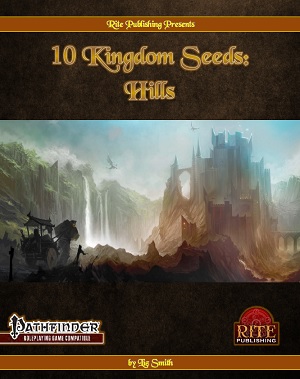
[Review]Rite Publishing’s 10 Kingdom Seeds: Hills

rp_tksh_coverThis is something which I should have posted a year ago. I was actually kinda surprised to find out that I hadn’t. SO without further ado:


Rite Publishing Presents 10 Kingdom Seeds: Hills by Liz Smith is part of a series providing the GM with short town descriptions she can easily plug-in into her game. These settlements are intended to be used as PC bases, as foundation stones to use with Pathfinder’s Kingdom Building Rules, but can as easily just be inserted into your setting, to fill empty regions between your big cities. And while they are written with hill terrain in mind, most of them aren’t so specific that they couldn’t be used with other terrain types as well.

The PDF consists of 9 pages, with 6 pages filled with actual content (plus cover, credits and OGL). Layout and page design is on a professional, high-level standard and I especially dig the artwork which would be worthy of any major publisher. Actual content are around half-page long descriptions of 10 settlements, ranging from Thorps to Villages. Each entry starts with the rule description (as seen first in Paizo’s Gamemastering Guide), followed by a short description of the look and the economy of each town. The last one being something I especially like as this is often the main reason why a settlement is founded at all and it immediately creates imaginery. One thing I also like is that those settlements are very varied as far as their main inhabitants‘ race is concerned. A chaotic good thorp inhabited by half-orcs can excellently serve to play with the player’s expectations (and if you’d rather have humans there, just change it, it’s no big deal)

Each entry also describes one or two important locations and concludes with some rumors about the settlement or its inhabitants which, while they sometimes feel like created with a random generator (which must not be a bad thing), still immediately add potential plot hooks and ideas to develop own adventures. I mean what could happen if a caravan with a holy sword comes to a village ruled by a CE cleric? (just to give an example). Here you find a village ruled by a bronze dragon, you have ghosts in the streets, cats stealing magic items (for what reason ever) or simply wandering hamlets made out of wheeled huts. So what this products really is successful at is to spark imagination without losing many words. The GM will have to work, if she wants to use these ideas, but she’ll have something to start with.

There are some things I have to criticize for honesty’s sake. The main criticism is directed at the rules section of each entry. As it seems, the designer forgot to include the modifiers from Table: Settlement Statistics into the settlement modifiers of each entry. There is also one major layout error in the Seahollow entry where the rules section has been divided by the text description. Minor mistakes (at least I think it wasn’t done intentionally) can be found in the rules sections for Starrywyn (Danger modifier should be -5 instead of +5) and Redhurst (being a thorp but using the magic item line for villages in the Marketplace section). I’m not the big rules guy, so this is nothing to put much importance in (maybe there are even reasons why there are so many items flowing around in Redhurst and why danger is higher in seemingly peaceful Starrywyn?) but if you’re using the settlement modifiers in actual play, you should be aware that you have to recalculate the modifiers according to the rules.

This all said, I can recommend this product. If you are building your own setting or if you’re using published settings, there will be empty places to fill and to do so, this product can be immensely helpful. This may not be obvious by the first look, but if you’re taking the time to really read the entries, you’ll find little, creativity sparking ideas helping you to really bring those settlements to live. So I’ll give it 4 out of five stars (a half star removed for the rules inconsistencies, another half star because some of the rumors seem a bit to random for my taste), because while not perfect, I’ll probably use all ten settlements in my homebrew (meaning that each of these settlements is worth way more than the 15 cents it costs, and that doesn’t even count in the splendid illustrations)

And so it began…

Musings„If it exists in D&D, then it has a place in Eberron!“

This bold statement was the start of it all. Part of the „Ten Things you need to know“ (in the Introduction of the Eberron Campaign Setting) totally got my attention. That a setting with such a different tone from the normal kitchen-sink D&D fantasy setting could still claim to be kitchen sink was something I’d never thought possible beforehand and made me rethink what I actually wanted to do with setting design. Now given the sheer masses of material written for any edition of the game, it seems physically impossible to do this, but at least this idea made me rethink my former policy of disallowing a lot of stuff which didn’t seem to fit into any given setting.

In the meantime, I’m all about allowing stuff, but under one condition: You have to be willing to modify the fluff to fit into the setting we chose to play (for example there are no Warforged in the Pathfinder Setting of Golarion, but with just a bit of rewriting, we surely could find a way to import them).

This is also the way I tend to read role-playing material from whatever source: How can I make it fit into my setting. So let’s that make RULE ONE for the design of Tetheril (the name of my world):

1. If it exists in Pathfinder, then it has a place in Tetheril!

And just to be clear: I do not intend to restrict myself to Paizo material only. But given that PFRPG is the engine that drives my game , this should be a minimum requirement. So I’ll give you rule 1.1

1.1. If it exists in the OGL universe, then it most probably has a place in Tetheril too.

And as if that wouldn’t be already overwhelming enough:

1.2. Without outright stealing, taking inspiration from D&D 1-5 or even other RPGs is explicitly allowed.

There are other rules I strive to follow:

2. The setting will be created through adventures first, through a campaign book second.

This is something that was originally the idea behind the Pathfinder Adventure Paths. Not to develop the setting through a lot of setting books but through the actual adventures written for Golarion. This policy has changed a bit in the meantime, and might also change for my setting someday, but at the moment, I hope that it will keep me from doing stuff that is not really useful at the moment. By the way, if I’m saying „book“, you’d better take this metaphorically. Maybe this will someday end in a publishable form, but that’s a long way to go, if I can go it at all.

3. Preference for low- to mid-level game.

I’m a big Eberron fan and what I think the setting did really well was to give a lot to play for characters between level 1-12. There were high-level dangers which would later be expanded upon, but at it’s core it wasn’t written with lower level characters in mind. I’ll try to take the same approach. Start small, but with the possibility to expand.

4. Low-magic approach

This is a bit tricky, so let me try to explain. One idea behind my setting is that magic has become scarce for some reason I’m not willing to share yet. There’s still magic there but mostly in the form of low-level magic. And (at least in the beginning) magic will even be more restricted for the player characters though that is something which will hopefully gradually change over time. So given what I said regarding point 3, I’m not sure if this will restrict player characters too much or at all, but if you expect the same magic level and magic wealth of the Realms, Golarion or other high-magic settings, you might get disappointed. This might also involve heavy tinkering with the rules and at least a bit nerfing of the Tier 1 and 2 classes.

5. Alignment isn’t what you think it is

This is also something I liked about Eberron, how it played with the alignment system (and thereby with the players‘ expectations). So I hope that I can create a setting where alignment isn’t something absolute but more of a gray area. And there might even come surprises in the form of inter-alignment alliances. So if you can’t handle Paladins working together with „evil“ persons, this setting might not be for you. There will be fight, there will be conflicts, but whose side you might find yourself fighting on has not necessarily to do with alignment

6. Culture and Race might define class choice

Well, in the beginning there won’t be many races to chose from because it will mostly center on humanity and there’s a lot of exploring to do. What I mean about that is that I will try to make cultural and racial choices of class and other options so appealing that players don’t necessarily look for the mechanically best option. There will be no hard restrictions, but setting-side it should be very clear that dwarves cannot take levels in the dragonrider class, because only elves have learned to tame those beasts and they don’t share the secret (just an example, which will most probably have nothing to do with my setting). So at least at my table, if a player comes up with this great idea for a dwarven dragonrider, he’d better have a good background explanation for how this came to be. Because, quite frankly, while I understand why official settings tend to be as nonrestrictive as possible, I don’t think that it necessarily makes for a good setting, if anything goes. Luckily, the Pathfinder archetype system gives me a lot to work with.

Well that’s it for today, but I wanted to get it out of my chest before I really start with working on my adventure.

[Review]Weekly Wonders – Villainous Archetypes Vol. II

WW-VA IIVillainous Archetypes: Vol. II is the latest entry in Necromancers of the Northwest’s Weekly Wonders series. As you may guess from the title, it’s about archetypes usable for evil characters, but is equally usable for GMs to create evil NPCs. It’s an 8-page PDF with 4 pages of actual content (the rest is front and back cover, credits and license stuff) which contains 5 archetypes.

The first one being the Brutal Oppressor, a barbarian archetype. With this one, you get to Swap Trap sense against Bully, which gives you a real nice use out of your Intimidate class skill. Which you can further improve with the Gory Display rage power which gives you an additional bonus on Intimidate with each successful critical hit. The other rage powers presented are Grab by the throat, which is more useful for the grappling barbarian, and Stay Down, which gives you an increasing damage bonus against prone opponents. And then there’s Bloodlust, a class ability replacing Tireless Rage, which potentially increases the number of rounds the barbarian can rage per day.

The second is the Elemental Defiler, a nice nod to the Dark Sun defiler of old and an archetype for the Kineticist. This archetype replaces Internal Buffer by Drain Energy, ability that basically does the same but is a bit more versatile, because you can use it, when you need it, and that you don’t need to accept burn to fill your buffer. On the other hand, you must use the won energy directly in the same round and the action provokes AoOs. And at Level 19, Drain Creature replaces Metakinetic Master and allows you to ignore burn according to the points of Constitution damage your opponent suffers.

The Extortioner is an Investigator archetype prone to blackmail his victims with the secrets he finds out. The Extortioner gets the Secret Finder class ability which improves and expands his trapfinding skill while losing his 3rd level investigator talent. Guilt Sense us a quite intriguing class ability which replaces boring trap sense. At the start, the extortioner gets a bonus on Sense Motive checks. At higher levels he also can cast detect thoughts as a spell-like ability, and even later on, he can force his victims to spill out secrets they are ashamed about. At fourth level, the extortioner replaces his swift alchemy class ability with Lingering Threat which improves upon the use of his Intimitade skill.

It seems as if the designers of this archetype felt it being a bit too strong, though, so they added Stunted Inspiration, which subtracts 1 point of Inspiration from the Extortioners inspiration pool. Seems more of a cosmetic change because in standard games, he might not really need all those inspiration points anyway.

The next one is the Villainous Bloodline for the sorcerer. Without going too much in detail, I generally like the conceptual idea, though the mechanics make it too easy to use it with actually good aligned characters. Ok, to inflict damage while simultaneously healing yourself (as the first level bloodline power Draining Touch allows) may not sound very goodish. And to paralyze your opponents and use them for protection (Hostage Taker at level 15) may also not be a sign for a true hero (though the problem is with the protection part and you don’t need to do this). On the other hand, neither Getaway (which allows you to escape via dimension door from narrow situations) nor the capstone ability Master of Deception are particularly evil in design and might come in handy for good-aligned characters as well.

And then there’s Villaneous Defenses, which might be much more powerful when used by good-aligned characters than by true villains. Reason being that you get DR/good, which might not be as efficient for a villain against a heroic group of adventurers, but can really help the Hero when fighting evil opponents.

This all said: you surely can use this with evil characters (especially when used in adventures where the opponents might even more evil), so it doesn’t actually goes against the designers‘ promise.

Last but not least, we have the Eldritch Slavemaster. This Summoner archetype forces his Eidolon(s) into his service rather than building a link to them. Which may have consequences in case he loses control over the summoned eidolon according to Conjurer’s Leash the replacement of 1st level’s Life Link. As this ability also comes with some restrictions regarding the distance allowed between summoner and eidolon, the designers added Slavedriver, an ability that let’s the eidolon cause more damage with successful hits, but also causes damage to the eidolon itself. At 4th level Shield Ally is replaced by Slave Shield. This ability lets the summoner decrease any hit point damage he suffers, but causes the eidolon to suffer twice the damage that its‘ slavemaster avoids. At 12th Level, Greater Slave Shield decreases the damage the Eidolon suffers this way. At 14th level, Drain Summoned Monster (self-explaining) replaces Life Bond and at 16th level, Explosive Summons replaces Merge Forms and allows the Summoner to use his summoned monsters as living bombs. And at level 20, Slave Army replaces Twin Eidolon and allows the slavemaster tohave summoned monsters and eidolon simultaneously, He can even have more than one summon monster or Gate spell active.

Summary: From 4 out of 5, the only archetype I would consider to be outright evil is the Eldritch Slavemaster. The other 4 can be surely used by evil, but also by non-evil characters. I mention this because I’m on of those GMs who normally not allows evil characters at his table but would probably allow those archetypes when set into the fitting context. But that’s not the important part. The important part is that you can create great evil PCs with them, and you can also use them to create interesting NPCs for your PCs to oppose. So the product does what it says, and it is doing it (in my opinion) without arising balance issues. I also didn’t stumble about glaring editorial issues. Meaning that I didn’t find anything which lets me substract points from the end note (maybe a half star for my issues with the Villainous bloodline sorcerer, but that I’d be inclined to round up).

So, 5 stars out of 5 it is.

My d6 New Year’s resolutions

MusingsNormally I’m not the type for New Year’s resolutions because I’ve experienced more than one time that I couldn’t keep them for what reasons ever (mostly because I got diverted by other goals). So, one week after New Year’s eve, I’m a bit surprised how this year those resolutions seem to pile up. In fact, I have to stop myself from inventing new ones just while writing this blog entry (quite unsuccessfully, to be honest, as this post started with an ‚d3‘ in the title :D).

In no particular order, those resolutions are:

1. losing some weight

2. writing one rpg-related review per week (at least 1 review of an Pathfinder 3pp product per month)

3. reading at least 1 book per week

4. writing at least one adventure with the ideas from John Fours Adventure Building Workshop

5. running an adventure as PbP (or over Roll20.net)

6. improving my guitar play

I probably should make this seven as I also want to work on my homebrew setting but as this may go hand-in-hand with the adventure writing process, I’ll subsume it under point 4.

At the moment I’m most confident about improving my guitar skill as I’m practicing nearly every day for at least half an hour. To read one book per week could get harder as it sounds, especially as some of the review items could be of the bigger sort and I don‘ t intend to cheat by counting them as read books. Reviewing one item per week shouldn’t be too hard though, as there are also shorter 3pp products waiting to be reviewed.

The other 3 resolutions I’m most concerned about. Generally I don’t find writing too hard. Nonetheless I keep finding excuses not to (and if it is writing blog posts about why I’m not writing an adventure, a short story or a novel instead), so this is definitely something which has to change, no matter how content (or discontent) I’ll be with the finished work.

And then there’s losing weight…

But just to keep book:

First finished review this Year: Rite Publishings 10 Kingdom Seeds: Hills (see next blog entry)

Currently reading: Dave Gross – Prince of Wolves

Written Words for my setting/adventure: 750

weight lost: None 😀

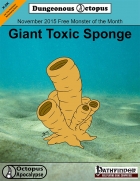
Motivating Monsters – The Giant toxic sponge

I hope that this will be the first in a series of articles taking a monster as inspiration for adventure and/or encounter creation. Monsters are one of the things D&D made me most exited about and to this day, I have problems to ignore monster books no matter the system they are written for. So there are already a lot of critters out there waiting for me to mull over them.

toxic-spongeOut of curiosity (once again), I picked up Octopus Games‘ Free Monster of November 2015, the Giant toxic sponge. This CR 5 monster lives at the bottom of the sea and is surprisingly mobile for a sponge. Main abilities are Siphon, with which the sponge creates a current drawing its prey towards itself and Swallow Whole (up two two creatures). Its Toxic Aura causes acid damage and may poison its prey. As long as you’re interested in underwater adventuring, it’s actually a nice little critter and the only thing I’d probably change is the poison-induced ability damage (from DEX to STR; the Save against the Siphon ability is strength-based so it would make sense to me if the Toxic Aura would attack the same ability, making the monster a little bit nastier .

And as this is what I’m most interested in (thinking about how to use the stuff I’m reading about), here are some ideas how to use the Giant toxic sponge.

1. The PCs are tasked to retrieve some treasure from a ship sunk before the coast during a heavy storm. Unluckily, the ship’s body has been infested by a pair of Giant toxic sponges feeding from the fauna living near the wrack. They won’t surely mind greater prey (like some meaty PCs for example who will literally have to go through the sponges to get what they came for.

2. When some townspeople go missing and the local authorities aren’t able to find any clues about their whereabouts, the PCs are hired to solve this riddle by the brother of a wealthy merchant who hasn’t been seen for several days. Hints point to a nearby lake and the PCs may find that the missed persons fell prey to a giant advanced toxic sponge. How did a salt water creature get into a sweet-water lake. And how is it able to survive there? The answers to these questions may lead to a mass murderer on the loose thinking he had found a way to commit the perfect crime.

3. For mysterious reasons a portal to the water plane opened in a big mountain cave looming over a little town. Poisonous Water pouring through the portal threatens to destroy the town but finding a way to close the portal involves exploring the cave. Meaning to handle the creatures coming through the portal as well as handling the portal itself which seems to be a gigantic living creature drawing the water out of the plane of water onto the material plane.

[Review]Otherworld Games – The Adventurer Princess

Well I’m still not quite sure what’s the best language to use in this blog, so I’ll do the next best thing and (if time allows) publish my entries in english and german. This time it’s about  aproduct I stumbled about by chance when looking for opportunities  to spend my money 😀

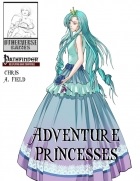
adv_princessChris A. Fields „Adventurer Princesses“ is a curious product, which made me a bit hesitant at first, but in the end, curiosity won.

The strangeness begins with the cover illustration, a manga-style princess in a blue ball gown and a golden crown on her head, which seems to fit in a grimm-style fairy tale but doesn’t seem too adventurous. I’m not too wrong with this interpretation but we’ll come back to that. The layout of the product is fine with and while I not particularly like all of the interior illustrations that’s certainly a matter of taste and it doesn’t take away from the product in any way.

The Strangeness continues with the categorization of the Adventurer Princess as a race (instead of a class as I had assumed first). So the product starts on the first three pages of this 16-page product with a description of the background of this „race“. Princesses typically aren’t of noble blood but most often maidens from the common folk who excel with courage, charisma and leadership abilities. And while they are humanoids with the human subtype, they have different racial traits; the have their own ability modifiers, start with an animal friend who functions like a wizard’s familiar, can choose between different skills they get bonuses for, and they get a 3x/day spell-like ability as a bard of the same level.

There are also some alternative racial traits offered, for example the Foreign Princess which enables you to play a non-human adventurer princess, or the Modern Princess to use in a modern setting (immediately Lara Croft comes to mind). For Xena-style characters, there is the Warrior Princess. Other alternatives modify the spell-like ability, the skill choices and look interesting and playable as well.

Next three pages are filled with 19 base character traits. For combat traits, we have the Air Princess (fly as class skill with +1 bonus on skill checks), the Dragon Slayer (bonus against dragon-type monsters) which I really like for how it plays with the normal stereotypes. The Duell Princess gets a magical one-hand weapon from the start and the Tomboy gets bonuses when competing with men (see my criticism at the end of the review).

With the magic traits we’ll finally land in the realms of Grimm fairy tales I alluded to at the start. Animal Helper makes Cinderella’s doves (or other animals) help with the daily chores and the Fairy-woven Finery obviously comes from the same source (the ball gown even changes back to normal at midnight), while the Little animated Buddy seems inspired by the Disney version of Beauty and the beast (I mean, come on, who wouldn’t want a two-legged candelabra as companion – or better yet- an animated snowman). The Ball-gown Parachute does exactly, what he says and the Elemental Birth Sign increases the damage of elemental spell damage. At last, there’s the Princess countersong, which enhances the respective bard’s class feature.

The social traits encompass the Centre of Courtly Life, the Fairest of them All (Mirror, Mirror…), the Orphan Princess (free Courtier’s Outfit), the Rat Princess (which prefers Intimidate over Diplomacy) and the Student of History, who gets bonuses on Knowledge (nobility) and Knowledge (history).

Finally, there are racial traits like the Fairie’s Blessing (Little Briar Rose says hello), the mysterious Night’s Princess (gets low-light vision) and the Sibling’s Bond which creates an especially narrow bond between Little Brother and Little Sister. This trait seems mechanically problematic, because it relates to the psion’s sense link ability which is known from 3.5 but has no official equivalent in Pathfinder. Now we have the Dreamscarred version, but as there’s no entry in the OGL section 15 and as this version not quite equals it’s predecessor, I assume that the author rather meant the older version. I guess one could easily adapt the Binder’s sense link ability but if so, that should be clarified in the text.

Now let’s return to the fairie tales realm with the racial feat Fairie Coach functioning like Disney’s Cinderella version (even transforming the animal friend into two coach horses). It gets even better at level 10 when you get two winged coach horses instead which enable the coach to soar through the air. The second racial feat, the Noble Equipage is a bit more down to earth and may be inspired by Joan of Arc. It’s mainly chivalric equipment you get (including a war horse or pony).

And then, there’s five and a half pages full of magic items. I won’t go into detail too much, but it’s 3 armors, 3 weapons and 10 wondrous items, some of them also inspired by Grimms‘ Fairie Tales. For example, there’s the Applewood Bow bestowing resistance bonuses against poisons, or the Princess‘ basket preparing fine meals from the raw ingredients put within. Another item, the Farie Dust, gold certainly takes its inspiration from Peter Pan (and I let you guess what it does 😉 )

Conclusion: I’m still not sure what to make out of this product. I can see the advantage in making the Adventure Princess a race rather than a class, because it enables the author to take inspiration from diverse sources; still, most members of this group are of human stock, so the concept doesn’t quite fit into this mechanic. Another thing is about the definition of this „race“. There’s basically no need for a category including extraordinary women in a game, which already defines an adventurer as an extraordinary person and makes it quite clear that men and women are absolutely equal in game terms. Which would make every female adventurer to an Adventurer Princess.

This said, I still like the product. I don’t think that children are it’s main target group but I guess that the fairie tale elements are perfect to introduce them into the game. I can easily imagine my daughter wanting to play an Adventurer Princess inspired by Frozen’s Elsa (especially if she is allowed to use an animated snowman as familiar). But even for me as a male adult, who likes to play female characters, the product contains quite some ideas to use in my own games. I mean; what’s not to love about Xena, Joan of Arc or Lara Croft inspired characters.

And even if you don’t like the Adventure Princess as a race (or even as a concept), the product still contains 16 pages full of rules material to use or be inspired from in your own game, and that for a real fair price. So 3 of 5 stars, because you still get useful material even if I have my doubts about the concept. Should you even like the concept, than add another star to my rating.

My Procrastination Blues

MusingsIn one of his first workshop videos, John Four talks about procrastination and what to do about it. Before I come to that, let me talk about my own procrastination problem which is kind of a constant in my whole life (Hi, my name is…). I seldom suffer under writer’s block. I also don’t lack ideas, quite the opposite. And that’s the problem because I can’t decide what idea to tackle first and I get sidetracked to easily.

I will not bore you to death with the story of my voyage to education, but let’s just say that nothing I chose to learn from childhood had any direct benefit for my later career decisions (apart from that I learned a lot about myself on this journey). I ran one way and at the next decision point, I ran into a totally different direction. I guess I finally arrived where I belong in the meantime but, man did I choose a complicated path to get there.

I also am collector of books and computer games and may not be physically able to read or play through them all because it’s just too much and the collections keep growing. But that’s not the problem. The problem is, that I can’t even decide what to read or play now and waste a lot of time by just thinking about it.

And it’s quite the same with roleplaying games. When I started with the adventure building workshop, I immediately had an idea I wanted to work with. Then I read through old blog entries and immediately had another idea equally appealing. Then I listened to the new album by Avatarium, „Girl with the raven mask“ (my personal album of the year and that’s with new albums by Maiden, Slayer, Amorphis, Blind Guardian, Kamelot and Nightwish …. but I digress) and immediately had the idea to build a whole campaign based on the songs on that album.

So if I talk about procrastination, that’s what it is for me. To be paralysed by so many options and instead just chosing one and go from there, I keep pondering and pondering (and accumulating other ideas). No easy way out of this and even though I already decided which idea I want to use for the workshop, it’s quite hard not to be distracted by those other things.

By the way, John suggested the so-called First Move as a means against procrastination. Each voyage starts with the first step, and the idea of the First Move just means to find that first step which will inspire you to take the second, the third and so on. This First Move can basically be anything what helps you start the journey. If you want to write an adventure you could start with a map of the adventure location, with a description of the location the adventure starts in. It could be the villain you want to set the heroes against, it could be a central scene you want to develop the adventure around and so on. The important thing is to identify what works for you as a first step and take this step every time you start a new voyage.

And I guess my First Move was to finally decide not to waste my time with thinking about what I want to do but just doing it. And if everything goes well, I still can realize those other ideas (or at least, some of them).

Ok, this is it….

So I finally decided to switch my blog (at least partly) to the english language, mainly due to the fact that most of the stuff I’m interested in is originally written in english anyways. Probably makes it a bit harder as it isn’t my native tongue, on the other hand it may well help me to focus on topics I wanna talk about as I have to concentrate just that bit more. But we’ll see how this will work out.

I’m Bjoern, 42 years old, three kids, full-time nurse and an avid roleplayer since I got introduced into this hobby 32 years ago. My first contact with this stuff was the computer game gem Bard’s Tale, soon followed by the first edition of Das Schwarze Auge, the most popular Pen&Paper here in Germany. Next was AD&D, then D&D 3rd ed., which in the Pathfinder variant has become my system to go for when I want to run things. For a short time I was part of the german PFRPG translation team but have gone back to full hobbyist status since then.

At the moment, I’m trying my hands at adventure creation and take part in GM Johnn Fours‘ Adventure Building Workshop. Now it’s not that I haven’t created my own stuff before but that was more on a when-needed basis and mostly was transported directly from my head to the game table. What I wanna find out now is if I’m able to create adventures (and as an extension, my own setting) in a more structured and probably even bring it in a publishable form.

But that’s a long way to go so let’s start with the first step. For those of you who don’t know him, John Four is the man behind the Roleplaying Tips blog, a dragon’s hoard full of great and mostly system-independent GM advice (which you can also subscribe to to get it via email). I really appreciate what John does there so when he announced his plan to produce an adventure building workshop I hadn’t to think twice about taking part in it. At the moment I’m working slowly throught the workshop videos and am still in the planning phase for what will hopefully become an ongoing (and unending^^) endeavor.

One of the things John suggested is a central database to store all the materials and ideas you may or may not need for your project. He’s using Evernote for the workshop and while I appreciate the power of the software and started to use it myself, I’m kinda hesitant to use it as storage for long-winded texts instead of short and concise notes. So that’s where this blog will come in handy, because blog and long-winded texts? Sounds like a perfect fit. I plan to use it as a journal during my voyage to my first written adventure but also to show off some of the materials I want to talk about.

Apart from that, I’ll continue to review stuff I like, to report my findings in the old Dragon and Dungeon Magazines, thoughts about the new 5th edition of DSA (not sure if this part will be in english cause, as I understand, Das Schwarze Auge never gained much traction outside of Germany so it may be of no interest to english speaking readers) and of D&D (big maybe, cause the last edition war made me lose much of my interest into D&D, especially as I don’t like their policy regarding setting-specific publications; on the other hand, I can’t keep mine from their adventures, so we’ll see). Add (another big maybe) the occasional music and/or comic review and (even BIGGER maybe) my political view on certain developments, and this is what this blog will be about. That’s why he is called „Wormy’s Worlds“ after all. Because I live in more than one.

[Wormy liest] Paizos Ultimate Campaign-Hardcover (Teil 2)

Ich bau mir einen Charakterhintergund, die erste

MusingsSo, da bin ich nun glücklich in Kapitel 1 des Ultimate Campaign-Hardcovers angekommen. Die ersten 8 Seiten behandeln in aller Kürze die Themen, mit denen man sich beim Hintergrundbasteln beschäftigen kann. Wobei von der Geburt über Kindheit und Jugend bis hin zum frühen Erwachsenenalter alle Bereiche angeschnitten werden, Wann wo und unter welchen Umständen wurde man geboren? Wer waren die Eltern, wo und in welchem sozialen Stand wuchs man auf? Gab es besondere Ereignisse um die Geburt herum (oder auch in der Kindheit und der Jugendzeit)? Welche Rolle spielten Magie und Religion, was für Freunde hatte man, wer waren Vorbilder? Wie kam es dazu, dass man in der gewählten Charakterklasse landete? Wer war die erste Liebe, was gab es für Konflikte, gibt es schmerzhafte Erfahrungen? Usw. Im Prinzip könnte man aus diesen 8 Seiten alleine schon einen Fragenkatalog erstellen, mit dem man einen sehr ausführlichen Charakterhintergrund entwerfen könnte. Aber ich liebe ja Tabellen und die kommen als nächstes:

Zuvor aber wird man aufgefordert, sich zu überlegen, welches Volk und welche Klasse man spielen und möchte und welchem Geschlecht der Charakter angehören soll, da davon teilweise abhängt, auf welchen Tabellen man würfelt. Ich überlege natürlich nicht, sondern würfle auch das aus und lande also per Zufall bei einer weiblichen Paktmagier-Elfe. Das ist wieder typisch, von alleine käme ich wohl nie auf die Idee, einen Paktmagier zu spielen. Aber gewürfelt ist gewürfelt, also nehm ich das als Herausforderung (und da ich inzwischen die Gelegenheit erhalten habe, an einer Online-runde teilzunehmen, ist es tatsächlich eine).

Kleine Anmerkung noch: Beim Würfeln erhält man je nach Ergebnis Zugang zu bestimmten, thematisch passenden Wesenszügen, Nachteilen oder auch den sogenannten Story feats (dazu später). Das ist natürlich alles optional, und kann auch einfach so gewählt werden.

Im ersten Schritt würfelt man seine Heimatregion aus. Auf der Elfentabelle erwürfele ich die ungewöhnliche Heimatregion, was meiner Elfe schon mal Zugang zum Wesenszug Forlorn verschafft. Lustigerweise würfele ich danach auf der Tabelle für ungewöhnliche Heimatregionen ausgerechnet den Wald aus, was für Elfen eigentlich die Hauptregion wäre. Egal, ich könnte also auch den Wesenszug Log Roller wählen.

Als nächstes würfele ich aus, wie es meinen Eltern geht, und wieviele Geschwister ich habe. Nun, meinen Eltern geht es beiden gut, außerdem habe ich 1 jüngeren Bruder. Danach stellt sich die Frage, was die Umstände meiner Geburt sind. Und schon wird es interessant, denn ich erwische den Eintrag außerhalb deines Volks adoptiert. Dafür gibt es eine eigene Tabelle, auf der man von Drachen über Untote bis hin zu Wilden Bestien alles mögliche erwischen kann. Ich hab allerdings das Glück und erwische die Zivilisierten Humanoiden. Da es dafür nun keine eigene Tabelle gibt, würfel ich schnell auf die Basisvölker und erwische die Menschen.

Jetzt hab ich schon vorgegriffen und geh noch mal einen Schritt zurück, um herauszufinden, welchen Beruf meine Eltern haben. Ich würfel gleich zweimal, einmal für meine echten, einmal für meine Adoptiveltern. Dabei zeigt sich, das meine biologischen Eltern Freibauern waren, während meine Adoptiveltern Kleinbauern bzw. sogar Leibeigene waren. Beides würde mir wieder zugang zu sozialen Wesenszügen bieten, ich entscheide mich aber natürlich für das meiner Menscheneltern, Poverty Stricken. Wäre ich ein Adeliger, gäbe es dafür auch noch eine Tabelle, aber so überspringe ich die natürlich und gehe weiter zu den wichtigeren Ereignissen meiner Kindheit. Auf der dazugehörigen Tabelle erwürfele ich den Eintrag Mentorship/Patronage, was mir Zugang zum Wesenszug Mentored verschafft.

Damit ist die Kindheit nun abgeschlossen und ich komme ins Jugendalter. Hier kommt nun erstmals meine Klasse ins Spiel. Auf der Tabelle für den Paktmagier erwürfele ich den Eintrag Stranger in your own Skin, was mir den Zugang zum magischen Wesenszug Linked Magic eröffnet. Als nächstes verschaffe ich mir einen einflussreichen Verbündeten; meiner ist der Champion (und wieder gibt’s einen Wesenszug, nämlich Ambitious. Womit ich auch schon durch die Jugend durch bin.

Ein recht interessantes System bietet der dritte Schritt, bei dem es um moralische Konflikte, Beziehungen und Rückschläge geht. Hier erwirbt man sich je nach Wurfergebnis bis zu 20 sogenannte Konfliktpunkte (CP), die dazu dienen, die eigene Gesinnung festzulegen. Als Konflikt erwürfele ich Verführer (3 CP), als Zentrum des Konflikts einen engen Freund und als Motivation für den Konflikt die Familie (3 CP). Jetzt dürfte ich mir noch frei aussuchen, wie der Konflikt sich auflöste, aber ich würfel sogar darauf und erhalte als Ergebnis Denial (+1 CP). Die somit insgesamt 7 CP kann ich nun auf die beiden Gesinnungsachsen verteilen, was mir die Wahl zwischen den Gesinnungen CG, NG, RN oder RE ermöglicht. Ganz hardcoremäßig würfel ich sogar das aus. CG heisst das Ergebnis, womit ich zugegebenerweise ganz glücklich bin.

Als nächstes darf ich mir meine Gottheit aussuchen. Müsste ich zwar nicht, mutigerweise würfele ich aber trotzdem und lande bei Shelyn; wobei ich zugeben muss, das bestimmte Götter an dieser Stelle zum Neuwurf geführt hätten; mit der Göttin der Kunst, der Schönheit und der Liebe lässt sich aber etwas anfangen. Wo wir grad bei der Liebe sind: auf der nächsten Tabelle geht es um romantische Beziehungen. Mein Ergebnis sind mehrere oberflächliche Beziehungen. Die nächste Tabelle lass ich aus, da es auf dieser um die Beziehung zu einem meiner Mitabenteurer geht, und das ja nicht ohne deren Zustimmung geht. Na gut, ich würfel trotzdem, aber bei dem Ergebnis kennen sich nur über ihren Ruf hätt ich das wohl auch lassen können.

Damit bin ich bei der letzten Tabelle angelegt. Paizo hat hier nämlich ein Nachteile-System implementiert, wobei es sich um Äquivalente zu den Wesenszügen handelt. Mit der Wahl eines solchen Nachteils kann man sich also ein drittes Wesensmerkmal zulegen (wenn der SL das zulässt). Ich würfel einfach mal und erwische passenderweise den Eintrag Liebe, was mir zu einem der besagten Nachteile, Liebeskrank, Zugang verschafft.

So, das ist jetzt länger geworden als ich dachte, deswegen verschieb ich die Ausarbeitung auf den nächsten Eintrag. Immerhin scheint sich da schon ein Thema anzudeuten. Den kompletten Charakter bin ich ebenfalls gerade am bauen, aber den werd ich dann wohl einfach verlinken.