Between Worlds: How to transfer campaigns to another setting (Part 1)

rpgblogcarnivallogosmallThis article is part of this month’s RPG Carnival as presented by Codex Anathema. It’s also part of what I hope will be a little series of blog posts dealing with different aspects of this month’s topic, “Locations, Locations, Locations”.

Meshing an adventure or a campaign with a setting it hasn’t originally been written for can be as easy or as complex as you’d like it to be. Homebrew or published adventure, generic or written with a specific campaign world in mind, in the end, it is your game, and you decide how much work you want to do to run it in the setting of your choice (and again, homebrew or published, it is your world, so it is your decision if you want to stay true to the setting’s lore or if you feel free to change all of it). This article will focus on the geographical part of that activity,because that’s what the RPG carnival is about, but of course, there’s also plot, time and other questions to consider, that I might deal with in another article.

Before we go into the different possibilities how to geographically mesh a campaign with a setting, I’d like to introduce my own motivation to do such a thing. First, I’ve been a big fan of the adventures published by Paizo since the time they used to publish good old Dungeon Magazine. I love the AP format, I love the stories they tell with their APs and with few exceptions, I consider their adventures better than most adventures published by other design companies. Second, I’m very much a Forgotten Realms guy, and while I do love Golarion (or the Age of Lost Omens setting, as it is called now), I find myself returning to my old love time and time again. The same goes, to a slightly lesser extent, for Eberron. So with my limited time, I had to decide for a single setting to run games in, and as long as my homebrew isn’t ready (which will probably be never), I decided to return to the Realms.

The easiest way to integrate an adventure into a setting, of course, is to just plug and play it into the campaign world. Even a setting like the Forgotten Realms with its extensive lore that has built over four decades and more still has blank areas to fill, so as long as the party doesn’t move out of that area, no one will see any inconsistencies with the setting’s original lore. That works especially good with players that have no knowledge about the setting in question. For example, if you want to run Paizo’s Ironfang Invasion AP in the Forgotten Realms (I chose that example because that’s what I’m actually doing right now), just put it in an undeveloped region in any of the frontier regions and be done with it. The AP is mostly self-contained, so it also won’t change much in the Realms if you don’t want to and even when the players decide to visit one of the nearby locations of the original setting, it won’t influence the plot of that AP too much.

Now this approach poses a simple question: if you do it this way, why even bothering with adapting the AP to another setting? Wouldn’t it be easier to just run the campaign in the setting it is originally written for? And yes, of course it would, but then, if you don’t have to put in much work and prefer to run it in another campaign world, why even care about that? Maybe you and/or your players simply prefer running the Realms, but also want to run that AP, so putting those two things together is the easiest way to have your cake and eat it too. And if you aren’t bothered too much about lore consistency, there’s simply no need to put in too much work.

Of course, a slightly more advanced approach would be to replace setting locations with the locations of the AP. That works especially well when the setting locations haven’t been dealt with extensively within the existing lore, and you can just use the campaign’s lore for that location instead. It’s a bit harder when you already have detailed write-ups for a location because then you have to decide if you want to use, let’s say, an original inn as described in the setting’s location or if you would rather use Phaendar’s Taproot inn as depicted in the AP. Still, renaming things to better fit the chosen setting’s nomenclature isn’t too hard and it automatically lends your game a bit of the new setting’s individual atmosphere, which is probably part of the reason you want to use that setting instead of the original one.

For me, the real fun starts when you want to make full use of the setting of your choice, which in my case is the Forgotten Realms; I don’t want to do a simple plug and play, I want to make the gameplay into a real Realms experience using all kinds of Realmslore to add detail to the game, but also to partly replace the Golarion-specific stuff from the AP. My approach still starts with the question where to put the AP into the Realms, but the answer to that question is heavily informed by information I find within the Realms stuff. Let’s again use the example of the Ironfang Invasion AP (and be warned, what follows contains slight spoilers, so if you are a prospective player of that campaign, think twice before you read any further).

Ironfang Invasion basically is about a hobgoblin invasion into the frontier-like region of Nirmathas, with the hobgoblin army’s leader planning to erect a new empire for her own people. For plot reasons, we’re looking for a heavily forested area, we also want the starting location to lie at a river that cannot be easily crossed. Looking through the campaign outline for Ironfang Invasion, we also want to have a nearby organisation of Rangers, we need a large town in the region, a big dwarven city (that will be kind of problem, but I’ll come back to that), and we also need a forest that is cursed by a blight that the PCs will have to cope with.

As an aside, what we don’t need is, interestingly enough, a version of Molthune for our Realms’ Nirmathas, because the conflict between these two countries, that plays such a defining role within Golarion’s lore, doesn’t factor into the AP’s narrative so we can simply ignore it. Now if you want to play on that element, there’s certainly places like the Dalelands to introduce that AP and use the Zhentarim as your opponent, but that isn’t what I was interested in. I wanted to have a place that could possibly serve to establish a new hobgoblin kingdom without stepping on too many toes, a region that was only sparsely populated and had no big power laying claims on those lands. Now I was reading up on all things Impiltur at that time and so it was more by chance that I stumbled over a region that seemed to fit my preferences pretty well: the Great Dale.

The Great Dale is one of those regions that has never gotten an in-depth treatment like other regions have, which is good because it allows me to insert a lot of stuff without having to care about creating setting inconsistencies. Meaning for example that I can take locations out of the Nesmian Plains gazetteer in the first Ironfang Invasion adventure. Or from several campaign setting books released by Paizo. But more importantly, even with the few things known about the Great Dale, I can cover most of the things mentioned before. The Great Dale is, to a large extent, sparsely populated, and similar to Nirmathas, the people who live there prefer to be left alone and don’t easily accept rulership by a foreign nation (there’s kind of a rulership I’ll need to deal with, but that isn’t a question of geography). To the north, there’s the Giantspire Mountains, and there’s a lot of hobgoblin tribes already united. There’s two big forests – mostly unexplored – that I can easily use for my needs. What’s even better, one of them is ruled by the Rotting Man who’s influence is poisoning the forest, so the blight I have need for? Already there. We also have a river, the Dalestream, running through a large part of the Dale. The Nentyar Hunter is a prestige class from the 3.5 sourcebook “Unapproachable East” that I can certainly use as a replacement for the AP’s Chernasado rangers.

The one thing I’m not sure about at this point of time is the location of Kraggodan, the dwarven city. I see basically two possibilities. Unapproachable East mentions shield dwarves living in the Giantspire mountains, so I simply could put the city there. On the other hand, I could also use Earthfast, a dwarven city already established in Realmslore located in the Earthfast mountains. Both locations have their pros and cons, but as those are mostly plot related, I’ll spare that topic for a follow-up article. For now, I’m content with the knowledge that I have this location also covered.

As you can see, I’m using a top to bottom approach here. I’ve chose the location based on some of the bigger elements of the campaign and have yet to start to fill in the little details. This time, and with this AP, that might be relatively easy, because there’s a lot of white space to fill, but if I had tried to run that AP directly in Impiltur, as I originally considered to do, I would have had a lot more work to do, because that region has been given much more love especially thanks to George Krashos, who wrote that beautiful article in Dragon #364. We might come back to that region at a later point of time (because, yes, I’ve got plans^^). Next time, I’ll try to go a bit more into detail, with the focus on “Trailof the Hunted”, the first part of the Ironfang Invasion AP.
[Rezi]Rogue Genius Games – The Tomb of Felgar the Goblin King

RGG-toFtGKRogue Genius Games ist einer meiner liebsten Kleinverlage aus der Pathfinderszene, insbesondere weil einer der Mitbegründer Owen K.C. Stephens ist, den ich als Designer wie als Person sehr schätze und der inzwischen wohl besser als festangestellter Paizo-Mitarbeiter und Chefdesigner des Starfinder Regelsystems bekannt ist. Als mir daher kürzlich eine Mail reinflatterte, die mich über ein riesiges RGG Bundle informierte, habe ich nicht lange zögern müssen, bevor ich mir das zulegte, immerhin sind das so etwa 390 PDFs für schlappe 30 Dollar (und weil ich schon einiges davon besaß, wurde es für mich nochmals deutlich billiger). Und in einem Anflug von Übermotivation hab ich auch gleich eines gelesen, um es hier in Rezension vorzustellen. Um genauer zu sein, hab ich die erste PDF ausgewählt, die laut Drivethru von dem Verlag in meinem Besitz ist, die aber witzigerweise noch dem Vorgängerverlag Super Genius Games gehört und damit gar kein Teil des Bundles war.
One night Stand – The Tomb of Felgar the Goblin King liegt mir in der überarbeiten Fassung von 2009 vor, die sich von der ursprünglichen Version von 2008 vor allem im Layout unterscheidet (das Layout der Originalversion lehnt sich an das Layout der früheren AD&D-Bücher an, während die Neuauflage klar an das Layout der 4. Edition von D&D angelehnt ist (es gibt übrigens auch eine 4E Variante dieses Abenteuers). Der Inhalt ist weitestgehend gleich geblieben.

Idee hinter diesem Produkt ist, dem Spielleiter ein Abenteuer an die Hand zu geben, für dessen Leitung er einen möglichst geringen Vorbereitungsaufwand betreiben muss. Das ist den Designern auch ganz hervorragend gelungen, führt allerdings auch zu einem recht großen Umfang für ein doch recht kurzes Abenteuer. Die PDF umfasst 34 Seiten, von denen eigentlich nur 4 der Beschreibung des eigentlichen Abenteuers dienen, dass von daher wohl ganz vorzüglich für einen One Night Stand dient. Der große Rest enthält insbesondere vollfarbige Kartenquadranten, die man ausdrucken, zusammenfügen und damit eine recht große Kampfkarte des titelgebenden Grabs erstellen kann. Besonderer Clou dabei ist, dass eine Reihe dieser Quadranten in einer alternativen Version vorliegen, die es dem SL ermöglichen, das zu erforschende Gebiet erst nach und nach aufzudecken, so dass die Spielern bestimmte Geheimnisse erst entdecken müssen, bevor sie auf der Karte sichtbar werden. Dazu kommt eine einseitige Gebietskarte für den Spielleiter selbst, der damit leichter den Überblick behält, sowie 4 Seiten, auf denen jeweils der für eine bestimmte Kampfbegegnung relevante Kartenabschnitt gezeigt wird, und die außerdem ausschneidbare Aufsteller enthalten, auf denen im Comicstil alle im Abenteuer benutzten Monster gezeichnet sind.

In der Neuauflage kommt noch eine Seite hinzu, die die wichtigsten Spielwerte der Monster enthält. Diese folgen der Darstellung der 4E-Monster und wirken damit sehr übersichtlich, obwohl auf einigen der Karten das Druckformat schon sehr klein gewählt wurde, so dass ich es auch bei großer Vergrößerung auf verschiedenen Geräten nicht wirklich lesen konnte und eher raten musste, was da stehen soll. Das ist aber auch mein einziger Kritikpunkt, ansonsten bekommt man hier ein wirklich toll aufbereitetes Kurzabenteuer, dass man locker an einem einzelnen Spielabend über die Bühne bringen kann.

Inhaltlich kann man natürlich kaum etwas zu dem Abenteuer sagen, ohne zu spoilern. Letzten Endes ist es nicht mehr als ein kleiner Dungeon Crawl, den man wahrscheinlich in jede Welt, in der es Goblins gibt, problemlos einbauen kann. Hintergrund ist, dass es einst eine größere Goblinzivilisation gab, Felgar ein legendenhafter Goblinkönig ist, dessen Grabmal eines der größten goblinischen Heiligtümer ist, dieses aber im Dunkel der Zeit verschollen ging und nun seiner Wiederentdeckung hart. Bis heute suchen die Goblins nach diesem Grab, und, man kann es bei dem Titel des Moduls wohl erraten, ist die Zeit bis zu seiner Wiederentdeckung nicht mehr fern.

Laut Cover ist das Modul für Charaktere der 2. bis 5. Stufe geeignet, wobei ich glaube, dass es für Charaktere der 2. Stufe sehr herausfordernd, für Charaktere der 5. Stufe aber schon deutlich zu einfach sein dürfte, die Wahrheit also wohl eher in der Mitte liegt. Ansonsten ist diese Modul wirklich hervorragend dazu geeignet, auf Halde zu liegen um in einem passenden Moment hervorgezaubert zu werden, wenn man mal nicht viel zeit zur Vorbereitung hatte. Darüber hinaus enthält es trotz der Kürze schöne Ideen, wie man den Hintergrund der eigenen Welt anreichern kann bzw. , wie man mit den Folgen der Entdeckung dieses Grabs umgehen kann.

Auch fast zehn Jahre später sehe ich daher allen Grund, eine Kaufempfehlung auszusprechen und gebe trotz des angesprochenen Schönheitsfehlers fünf von fünf möglichen Sternen.

Staring at Monsters – The Alp

In my last post, I said I would steal a lot from other bloggers, even if it’s only the idea. One such idea stems from The Daily Bestiary by Blogger Patch, a blog that goes through diverse Bestiaries since 2011, taking one monster at a time, commenting on their backgrounds and powers and then adding their own adventure ideas, 3 at a time. Initially, I thought about just taking those ideas and fleshing them out a bit (something I still might do), but then I thought I could give it a try myself and do my own adventure spark stuff. Apart from that, Patch started with the original Paizo Bestiary, and the first entry in it just happens to be the Aasimar, so I was willing to take that as an excuse to start with the much more recent Bestiary 6 instead.

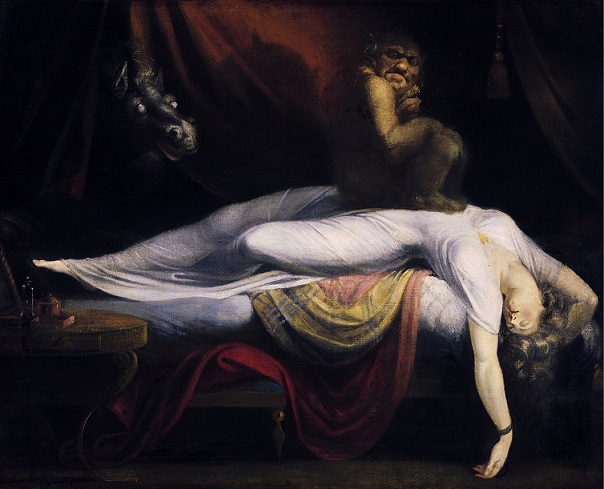
Which has the Alp as it’s first entry, an old mythological creature whose name’s related to the English „elf“ that sits on a sleeper’s chest at night, causing them to have nightmares (which is „Alptraum“ in German) and drinking it’s victim’s blood. Originally thought off as a nature god, the Alp would turn into a demon in the middle ages, and it’s easy to see how the stories around it might be early predecessors of what would eventually become the vampire. While doing a bit of research on that topic, I also stumbled about an interesting article about sleep paralysis, which I found very enlightening and that also theorized about the existence of those creatures being early explanations for that phenomenon.

John_Henry_Fuseli_-_The_Nightmare

By Johann Heinrich Füssliwartburg.eduimage, common license, Link

It is easy to see how the bestiary entry turn’s this creature’s traits into monster abilities. The Alp (CR 10) has several spell-like abilities like Deep Slumber and Nightmare, it can turn invisible via Greater Invisibility (in folklore, the Alp is often narrated as wearing a Tarnkappe, like King Alberich from the Nibelungenlied used to, before he lost it to Sigfried. It has a bite attack, draining it’s victims blood, and with the special abilities Crushing Leap and Nightmare Rider, it is able to pin and grapple it’s victim, making itself so heavy in the process that the victim gets serious problems with breathing. It even can shape-change into several smaller animals.

What I find interesting is that the entry makes the Alp‘ alignment into a Chaotic Neutral rather than an Evil entity. And in fact, mythology hints at Alps being able to be negotiated with, and while being mischievous in nature, they are not necessarily out to kill other beings, which I think would make for a rather interesting approach to a scenario, in which the PCs have to use their brains rather than their swords to get rid of such a beast.

But you know what? I already have nearly used all my 500 words for today, and one thing I want to avoid very much for the time being is to go over that limit, so my adventure ideas must wait until tomorrow, which also means that I’ll have another 500 words and can do a bit more than short online descriptions.

Word count day 1: 517.

[Review]Weekly Wonders-Drunkard’s Grimoire

Weekly Wonders – Drunkard’s Grimoire by Necromancers of the Northwest is a collection of 12 alcohol-based spells presented in the artistic style typical for those product (nice tome-like cover, a few black and white illustration inside the book.) As stated in the introduction, those should serve to extend that theme on spell-casters and is partly inspired by the Cult of Dionysos, while so far, mainly Monks and Barbarians had alcohol-themed archetypes. Also in the introduction is printed a list of official alcohol-based content. It seems not to be complete (a short Google search pointed me at the official combat trait „Accelerated Drinker“), but I still give bonus points for including that, because it is also stated that the part of the spells work in conjunction with those class features and archetypes, so to have this ready as a reference may come in handy. There’s also a hint at another Weekly Wonders Issue (Drunken Feats), that also might work with those spells, but as I don’t have that product (yet), I can’t say if that’s the case.

With two exceptions, the spells are cast at either a living creature or at a drink that has then to be imbibed for the spell’s effect to take place. In those cases, the drink in question can be drunk as part of the spell casting, so the casting time is unaffected by that (same goes for alchemists that might use such a spell). To give an impression, a short description of some of the spells follows:

Beer Goggles: impairs the sight of the drinker, who gains save bonus against gaze attacks, but also becomes more susceptible to diplomacy checks and charm effects.

Blackout: impairs the target’s ability to form memories, so they can’t remember what happened after.

Deadly Tankards: makes tankards into weapons. Also, you won’t spill the content while using them this way.

Valorous Whiskey: Drinker gains cold resistance and a morale bonus on attack rolls saves and some checks.

In the end, if I had one thing to criticize, then that some of the spells would require the GM to work with the player spell-caster (because there’s no use casting a spell on some drinks if the NPCs simply won’t drink them), which might be a con for players who don’t like such dependencies. On the other hand, as the GM, I immediately had some ideas how to use some spells even to introduce the players into a new adventure, so at least to me, they have a positive inspiration factor. And that you can use some of them as buff spells with (rum) flavor is something I really like very much. Mechanically, the levels of the respective spells seem right to me, and I wouldn’t have any problem if one of my players would want to use some of them. So if you like the theme of this product, I think it’s well worth it’s price and grant it full five stars.

Sales Madness at Open Gaming Store

MusingsFor all of you who like what Raging Swann Press and Dreamscarred Press have published over the years, there’s a real treat right over at the Open Gaming Store. Both Publishers have bundled several thousand pages of roleplaying awesomeness and until the end of October, you can be it for less then 30 $ per pack. Dreamscarred Press is known for its high quality Psionice material, which fills a niche Pathfinder obviously didn’t want to handle. This thing is even for those people who prefer the good old 3.5 over Pathfinder, because there’s the whole 3.5 back catalogue in it. And naturally there’s a lot of Pathfinder stuff too.
Raging Swann Press is dedicated to providing a lot of GM-friendly material which is generic enough to be easily used in every kind of campaign, but also stuffed with awesome ideas to spark whole adventures. Totally worth its price if you ask me.


[Review]Rite Publishing’s 10 Kingdom Seeds: Hills

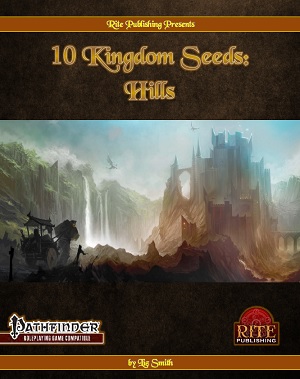
rp_tksh_coverThis is something which I should have posted a year ago. I was actually kinda surprised to find out that I hadn’t. SO without further ado:


Rite Publishing Presents 10 Kingdom Seeds: Hills by Liz Smith is part of a series providing the GM with short town descriptions she can easily plug-in into her game. These settlements are intended to be used as PC bases, as foundation stones to use with Pathfinder’s Kingdom Building Rules, but can as easily just be inserted into your setting, to fill empty regions between your big cities. And while they are written with hill terrain in mind, most of them aren’t so specific that they couldn’t be used with other terrain types as well.

The PDF consists of 9 pages, with 6 pages filled with actual content (plus cover, credits and OGL). Layout and page design is on a professional, high-level standard and I especially dig the artwork which would be worthy of any major publisher. Actual content are around half-page long descriptions of 10 settlements, ranging from Thorps to Villages. Each entry starts with the rule description (as seen first in Paizo’s Gamemastering Guide), followed by a short description of the look and the economy of each town. The last one being something I especially like as this is often the main reason why a settlement is founded at all and it immediately creates imaginery. One thing I also like is that those settlements are very varied as far as their main inhabitants‘ race is concerned. A chaotic good thorp inhabited by half-orcs can excellently serve to play with the player’s expectations (and if you’d rather have humans there, just change it, it’s no big deal)

Each entry also describes one or two important locations and concludes with some rumors about the settlement or its inhabitants which, while they sometimes feel like created with a random generator (which must not be a bad thing), still immediately add potential plot hooks and ideas to develop own adventures. I mean what could happen if a caravan with a holy sword comes to a village ruled by a CE cleric? (just to give an example). Here you find a village ruled by a bronze dragon, you have ghosts in the streets, cats stealing magic items (for what reason ever) or simply wandering hamlets made out of wheeled huts. So what this products really is successful at is to spark imagination without losing many words. The GM will have to work, if she wants to use these ideas, but she’ll have something to start with.

There are some things I have to criticize for honesty’s sake. The main criticism is directed at the rules section of each entry. As it seems, the designer forgot to include the modifiers from Table: Settlement Statistics into the settlement modifiers of each entry. There is also one major layout error in the Seahollow entry where the rules section has been divided by the text description. Minor mistakes (at least I think it wasn’t done intentionally) can be found in the rules sections for Starrywyn (Danger modifier should be -5 instead of +5) and Redhurst (being a thorp but using the magic item line for villages in the Marketplace section). I’m not the big rules guy, so this is nothing to put much importance in (maybe there are even reasons why there are so many items flowing around in Redhurst and why danger is higher in seemingly peaceful Starrywyn?) but if you’re using the settlement modifiers in actual play, you should be aware that you have to recalculate the modifiers according to the rules.

This all said, I can recommend this product. If you are building your own setting or if you’re using published settings, there will be empty places to fill and to do so, this product can be immensely helpful. This may not be obvious by the first look, but if you’re taking the time to really read the entries, you’ll find little, creativity sparking ideas helping you to really bring those settlements to live. So I’ll give it 4 out of five stars (a half star removed for the rules inconsistencies, another half star because some of the rumors seem a bit to random for my taste), because while not perfect, I’ll probably use all ten settlements in my homebrew (meaning that each of these settlements is worth way more than the 15 cents it costs, and that doesn’t even count in the splendid illustrations)

Awoken from a long slumber

MusingsAn e-mail I got woke me from my slumber. It informed me of the fact, that Johnn Four’s Adventure Workshop (I already talked about that) goes into its next incarnation, meaning that Johnn rearranged the old videos and put them together in a new format accessible to new and old participants alike (I have no idea if it costs anything for newcomers, as a participant of the original workshop I had immediate access, then we paid a small fee I still consider to be well-spent money).

Well. That e-mail also reminded me of the fact that I had wasted to much time with not doing anything creative, so I’d just give it a new try, the blog as well as the workshop. And as I started it from anew, I came upon my first task, namely doing my First Move. This term describes the first step you take into the design process and Johnn suggests, you try to find something what works for you and start the process with excactly this thing everytime. For adventure writing, things that automatically come to mind are the heroes‘ home base or a map of the location the adventure plays in. Could also be the adventure’s villain or anything which gets your creative juice flowing (which is what the First Move actually is supposed to do).

Now in my case this is a bit more complicated, because I don’t only intend to write an adventure, but also to design the setting in which this adventure plays. This setting is based on a lot of ideas I had in the last 15 to 20 years that I never got penned down on paper. And some of the ideas may require tinkering with the system (or, to be honest, rewrite it in a way that fits my vision) but I’ll leave that aside for now. Which means that I’ll probably start with a more generic version of the adventure and change it later according to my needs.

At first I just wanted to tackle the ideas I had through the first workshop. Without going into too much detail, the adventure was planned to start in a city which would only serve as location for this single module (I already planned for a bigger campaign arc which would mostly play at another continent). In the meantime, I think that would have actually been a waste of opportunity to explore said city and thereby explore one of the base premises of my whole setting. So I decided just to stay in this city for a while. Meaning that my First Move would be to think about this city with the intension to flesh it out at a later time.

And while I already had some ideas of my own, I still like to add a random aspect to my creations to challenge myself thinking in new directions, so I decided to roll the dice to create a Stat Block for my city using the Pathfinder settlement rules from Pathfinder’s Game Mastery Guide. Just to have more material, I added stuff from a thread in the Paizo forums which made it into Nairbs Settlement Creator. I did the same with Otherverse Games‘ “Cityscapes – New Settlement Options for the Pathfinder Roleplaying Game”. And then I let the dice decide.

Here’s what I came up with for a start:

Settlement Type: Metropolis

Population: 67315

Alignment: Lawful Good

Government: Council

Qualities: Defensible, Eldritch, Good Roads, Pocket Universe, Unaging, Hardened

Next time, I’ll tell you a bit what I intend to do with this stats and how it fits into my larger vision of my setting.

[Review]Weekly Wonders – Villainous Archetypes Vol. II

WW-VA IIVillainous Archetypes: Vol. II is the latest entry in Necromancers of the Northwest’s Weekly Wonders series. As you may guess from the title, it’s about archetypes usable for evil characters, but is equally usable for GMs to create evil NPCs. It’s an 8-page PDF with 4 pages of actual content (the rest is front and back cover, credits and license stuff) which contains 5 archetypes.
The first one being the Brutal Oppressor, a barbarian archetype. With this one, you get to Swap Trap sense against Bully, which gives you a real nice use out of your Intimidate class skill. Which you can further improve with the Gory Display rage power which gives you an additional bonus on Intimidate with each successful critical hit. The other rage powers presented are Grab by the throat, which is more useful for the grappling barbarian, and Stay Down, which gives you an increasing damage bonus against prone opponents. And then there’s Bloodlust, a class ability replacing Tireless Rage, which potentially increases the number of rounds the barbarian can rage per day.

The second is the Elemental Defiler, a nice nod to the Dark Sun defiler of old and an archetype for the Kineticist. This archetype replaces Internal Buffer by Drain Energy, ability that basically does the same but is a bit more versatile, because you can use it, when you need it, and that you don’t need to accept burn to fill your buffer. On the other hand, you must use the won energy directly in the same round and the action provokes AoOs. And at Level 19, Drain Creature replaces Metakinetic Master and allows you to ignore burn according to the points of Constitution damage your opponent suffers.

The Extortioner is an Investigator archetype prone to blackmail his victims with the secrets he finds out. The Extortioner gets the Secret Finder class ability which improves and expands his trapfinding skill while losing his 3rd level investigator talent. Guilt Sense us a quite intriguing class ability which replaces boring trap sense. At the start, the extortioner gets a bonus on Sense Motive checks. At higher levels he also can cast detect thoughts as a spell-like ability, and even later on, he can force his victims to spill out secrets they are ashamed about. At fourth level, the extortioner replaces his swift alchemy class ability with Lingering Threat which improves upon the use of his Intimitade skill.

It seems as if the designers of this archetype felt it being a bit too strong, though, so they added Stunted Inspiration, which subtracts 1 point of Inspiration from the Extortioners inspiration pool. Seems more of a cosmetic change because in standard games, he might not really need all those inspiration points anyway.

The next one is the Villainous Bloodline for the sorcerer. Without going too much in detail, I generally like the conceptual idea, though the mechanics make it too easy to use it with actually good aligned characters. Ok, to inflict damage while simultaneously healing yourself (as the first level bloodline power Draining Touch allows) may not sound very goodish. And to paralyze your opponents and use them for protection (Hostage Taker at level 15) may also not be a sign for a true hero (though the problem is with the protection part and you don’t need to do this). On the other hand, neither Getaway (which allows you to escape via dimension door from narrow situations) nor the capstone ability Master of Deception are particularly evil in design and might come in handy for good-aligned characters as well.

And then there’s Villaneous Defenses, which might be much more powerful when used by good-aligned characters than by true villains. Reason being that you get DR/good, which might not be as efficient for a villain against a heroic group of adventurers, but can really help the Hero when fighting evil opponents.

This all said: you surely can use this with evil characters (especially when used in adventures where the opponents might even more evil), so it doesn’t actually goes against the designers‘ promise.

Last but not least, we have the Eldritch Slavemaster. This Summoner archetype forces his Eidolon(s) into his service rather than building a link to them. Which may have consequences in case he loses control over the summoned eidolon according to Conjurer’s Leash the replacement of 1st level’s Life Link. As this ability also comes with some restrictions regarding the distance allowed between summoner and eidolon, the designers added Slavedriver, an ability that let’s the eidolon cause more damage with successful hits, but also causes damage to the eidolon itself. At 4th level Shield Ally is replaced by Slave Shield. This ability lets the summoner decrease any hit point damage he suffers, but causes the eidolon to suffer twice the damage that its‘ slavemaster avoids. At 12th Level, Greater Slave Shield decreases the damage the Eidolon suffers this way. At 14th level, Drain Summoned Monster (self-explaining) replaces Life Bond and at 16th level, Explosive Summons replaces Merge Forms and allows the Summoner to use his summoned monsters as living bombs. And at level 20, Slave Army replaces Twin Eidolon and allows the slavemaster tohave summoned monsters and eidolon simultaneously, He can even have more than one summon monster or Gate spell active.

Summary: From 4 out of 5, the only archetype I would consider to be outright evil is the Eldritch Slavemaster. The other 4 can be surely used by evil, but also by non-evil characters. I mention this because I’m on of those GMs who normally not allows evil characters at his table but would probably allow those archetypes when set into the fitting context. But that’s not the important part. The important part is that you can create great evil PCs with them, and you can also use them to create interesting NPCs for your PCs to oppose. So the product does what it says, and it is doing it (in my opinion) without arising balance issues. I also didn’t stumble about glaring editorial issues. Meaning that I didn’t find anything which lets me substract points from the end note (maybe a half star for my issues with the Villainous bloodline sorcerer, but that I’d be inclined to round up).

So, 5 stars out of 5 it is.

Motivating Monsters – The Giant toxic sponge

I hope that this will be the first in a series of articles taking a monster as inspiration for adventure and/or encounter creation. Monsters are one of the things D&D made me most exited about and to this day, I have problems to ignore monster books no matter the system they are written for. So there are already a lot of critters out there waiting for me to mull over them.

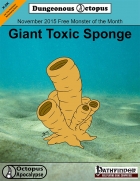
toxic-spongeOut of curiosity (once again), I picked up Octopus Games‘ Free Monster of November 2015, the Giant toxic sponge. This CR 5 monster lives at the bottom of the sea and is surprisingly mobile for a sponge. Main abilities are Siphon, with which the sponge creates a current drawing its prey towards itself and Swallow Whole (up two two creatures). Its Toxic Aura causes acid damage and may poison its prey. As long as you’re interested in underwater adventuring, it’s actually a nice little critter and the only thing I’d probably change is the poison-induced ability damage (from DEX to STR; the Save against the Siphon ability is strength-based so it would make sense to me if the Toxic Aura would attack the same ability, making the monster a little bit nastier .
And as this is what I’m most interested in (thinking about how to use the stuff I’m reading about), here are some ideas how to use the Giant toxic sponge.

1. The PCs are tasked to retrieve some treasure from a ship sunk before the coast during a heavy storm. Unluckily, the ship’s body has been infested by a pair of Giant toxic sponges feeding from the fauna living near the wrack. They won’t surely mind greater prey (like some meaty PCs for example who will literally have to go through the sponges to get what they came for.

2. When some townspeople go missing and the local authorities aren’t able to find any clues about their whereabouts, the PCs are hired to solve this riddle by the brother of a wealthy merchant who hasn’t been seen for several days. Hints point to a nearby lake and the PCs may find that the missed persons fell prey to a giant advanced toxic sponge. How did a salt water creature get into a sweet-water lake. And how is it able to survive there? The answers to these questions may lead to a mass murderer on the loose thinking he had found a way to commit the perfect crime.

3. For mysterious reasons a portal to the water plane opened in a big mountain cave looming over a little town. Poisonous Water pouring through the portal threatens to destroy the town but finding a way to close the portal involves exploring the cave. Meaning to handle the creatures coming through the portal as well as handling the portal itself which seems to be a gigantic living creature drawing the water out of the plane of water onto the material plane.

[Review]Otherworld Games – The Adventurer Princess

Well I’m still not quite sure what’s the best language to use in this blog, so I’ll do the next best thing and (if time allows) publish my entries in english and german. This time it’s about  aproduct I stumbled about by chance when looking for opportunities  to spend my money 😀

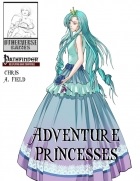
adv_princessChris A. Fields „Adventurer Princesses“ is a curious product, which made me a bit hesitant at first, but in the end, curiosity won.

The strangeness begins with the cover illustration, a manga-style princess in a blue ball gown and a golden crown on her head, which seems to fit in a grimm-style fairy tale but doesn’t seem too adventurous. I’m not too wrong with this interpretation but we’ll come back to that. The layout of the product is fine with and while I not particularly like all of the interior illustrations that’s certainly a matter of taste and it doesn’t take away from the product in any way.

The Strangeness continues with the categorization of the Adventurer Princess as a race (instead of a class as I had assumed first). So the product starts on the first three pages of this 16-page product with a description of the background of this „race“. Princesses typically aren’t of noble blood but most often maidens from the common folk who excel with courage, charisma and leadership abilities. And while they are humanoids with the human subtype, they have different racial traits; the have their own ability modifiers, start with an animal friend who functions like a wizard’s familiar, can choose between different skills they get bonuses for, and they get a 3x/day spell-like ability as a bard of the same level.

There are also some alternative racial traits offered, for example the Foreign Princess which enables you to play a non-human adventurer princess, or the Modern Princess to use in a modern setting (immediately Lara Croft comes to mind). For Xena-style characters, there is the Warrior Princess. Other alternatives modify the spell-like ability, the skill choices and look interesting and playable as well.

Next three pages are filled with 19 base character traits. For combat traits, we have the Air Princess (fly as class skill with +1 bonus on skill checks), the Dragon Slayer (bonus against dragon-type monsters) which I really like for how it plays with the normal stereotypes. The Duell Princess gets a magical one-hand weapon from the start and the Tomboy gets bonuses when competing with men (see my criticism at the end of the review).

With the magic traits we’ll finally land in the realms of Grimm fairy tales I alluded to at the start. Animal Helper makes Cinderella’s doves (or other animals) help with the daily chores and the Fairy-woven Finery obviously comes from the same source (the ball gown even changes back to normal at midnight), while the Little animated Buddy seems inspired by the Disney version of Beauty and the beast (I mean, come on, who wouldn’t want a two-legged candelabra as companion – or better yet- an animated snowman). The Ball-gown Parachute does exactly, what he says and the Elemental Birth Sign increases the damage of elemental spell damage. At last, there’s the Princess countersong, which enhances the respective bard’s class feature.

The social traits encompass the Centre of Courtly Life, the Fairest of them All (Mirror, Mirror…), the Orphan Princess (free Courtier’s Outfit), the Rat Princess (which prefers Intimidate over Diplomacy) and the Student of History, who gets bonuses on Knowledge (nobility) and Knowledge (history).

Finally, there are racial traits like the Fairie’s Blessing (Little Briar Rose says hello), the mysterious Night’s Princess (gets low-light vision) and the Sibling’s Bond which creates an especially narrow bond between Little Brother and Little Sister. This trait seems mechanically problematic, because it relates to the psion’s sense link ability which is known from 3.5 but has no official equivalent in Pathfinder. Now we have the Dreamscarred version, but as there’s no entry in the OGL section 15 and as this version not quite equals it’s predecessor, I assume that the author rather meant the older version. I guess one could easily adapt the Binder’s sense link ability but if so, that should be clarified in the text.

Now let’s return to the fairie tales realm with the racial feat Fairie Coach functioning like Disney’s Cinderella version (even transforming the animal friend into two coach horses). It gets even better at level 10 when you get two winged coach horses instead which enable the coach to soar through the air. The second racial feat, the Noble Equipage is a bit more down to earth and may be inspired by Joan of Arc. It’s mainly chivalric equipment you get (including a war horse or pony).

And then, there’s five and a half pages full of magic items. I won’t go into detail too much, but it’s 3 armors, 3 weapons and 10 wondrous items, some of them also inspired by Grimms‘ Fairie Tales. For example, there’s the Applewood Bow bestowing resistance bonuses against poisons, or the Princess‘ basket preparing fine meals from the raw ingredients put within. Another item, the Farie Dust, gold certainly takes its inspiration from Peter Pan (and I let you guess what it does 😉 )

Conclusion: I’m still not sure what to make out of this product. I can see the advantage in making the Adventure Princess a race rather than a class, because it enables the author to take inspiration from diverse sources; still, most members of this group are of human stock, so the concept doesn’t quite fit into this mechanic. Another thing is about the definition of this „race“. There’s basically no need for a category including extraordinary women in a game, which already defines an adventurer as an extraordinary person and makes it quite clear that men and women are absolutely equal in game terms. Which would make every female adventurer to an Adventurer Princess.

This said, I still like the product. I don’t think that children are it’s main target group but I guess that the fairie tale elements are perfect to introduce them into the game. I can easily imagine my daughter wanting to play an Adventurer Princess inspired by Frozen’s Elsa (especially if she is allowed to use an animated snowman as familiar). But even for me as a male adult, who likes to play female characters, the product contains quite some ideas to use in my own games. I mean; what’s not to love about Xena, Joan of Arc or Lara Croft inspired characters.

And even if you don’t like the Adventure Princess as a race (or even as a concept), the product still contains 16 pages full of rules material to use or be inspired from in your own game, and that for a real fair price. So 3 of 5 stars, because you still get useful material even if I have my doubts about the concept. Should you even like the concept, than add another star to my rating.