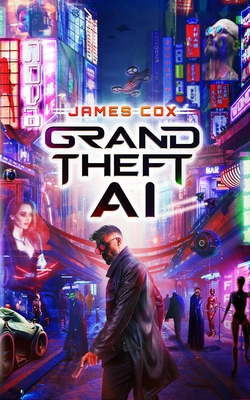
Grand Theft AI is a debut novel by film and music video director James Cox. I have to admit that I didn’t know anything about him beforehand, but at least 2003‘s Wonderland movie sounds interesting if only for the cast including all-time greats like Val Kilmer and Carrie Fisher. The reason I bring this up is that that flick seems to be known for it’s use of the Rashomon effect, which we also can see in the book happening to an extent, but I’ll come to that.
Grand Theft AI is a dystopian near-future thriller starting out as a heist story, in which a group of societal misfits tries to rob the city’s crime boss in order to finance themselves a good life in a world that has turned against them. Every single person in that book is somehow affected by an event called „The Glitch“, in which the computer intelligence got infected by a virus and robots and androids run amok, murdering over 32.000 people because things got under control again.
I don’t want to go into too much detail here because the book’s full of small chapters detailing the past of the characters, and that’s part of the charm of the book. Baz Corvane is an ex-soldier turned criminal, trying to find a way out of the business and dreaming to live the rest of his live happily on Tahiti. Ria Rose is the fixer for local crime boss Otto Rex who runs The Fang, a disco bar covering his more shady dealings in what goes as drugs in 2051, Narcsoft, basically software on a stick connected to your brain. Long story short, when a deal between Baz and Ria goes wrong, the two decide to plan a heist together to rob Otto blind and then fulfilling their dreams with the money the make out of it. They hire a bunch of other misfits, and then of course a lot of action, surprising turn of events ensue until at the end the story gets completely turned upside down.
As said, the world that is America in 2050 feels very dystopian. Computer Science and AI have improved since our day up to the point that robots and androids became able to take over workload from humanity. And of course that wasn’t used to turn human lives into something better but to further concentrate the wealth into the hands of a few capitalistic assholes, while the rest of humanity was kept at minimum wages and basically treated like useless rabble. When the Glitch happened that got even worse because instead of realizing that maybe it wasn’t that good of an idea to completely rely on AI and robots, those got just dumbed down enough to not be able to be dangerous anymore, even if that meant they weren’t as effective at work as they used to be.
The cover page claims the book as The Matrix meets Blade Runner, but in my opinion that claim holds only partly true. There are surely some similarities to the themes of Blade Runner, especially as it also poses questions about what makes a human human but the Matrix comparison doesn’t really hold true. Yes, humans flee the sad reality by means of Narcsoft, but the world isn’t run by AI (yet) extorting humanity like they did in The Matrix. To me the whole setting feels much more akin to a dystopian Ocean 11 heist story, basically what Shadowrun roleplayers are used to in their adventures. Without magic, elves and orcs of course, but if we really want to talk Matrix, it’s more Shadowrun’s Matrix than those of the Wachowski sisters.
The book itself consists basically of two parts. The first is that mentioned heist story, which also includes introducing the different characters, There’s a lot of exposition with backstory chapters here, but those are pretty seemlessly integrated into the main story so it didn’t bother me to have them and they really helped to understand the characters’ motivations (that even includes Otto Rex, though nothing you learn about him changes the fact that he is a highly intelligent, but murderous and psychopathic SOB.
The the heist happens, and in true Shadowrun fashion (I’m not making that mention without reason, after all), everything turns south very fast, the situation completely changes and suddenly the stakes are much higher than before (basically now it’s about rescuing humanity). Or at least you think that it is, because at the end, when you think you have figured out what everything is all about, the author suddenly turns most of what you thought to be true on it’s head and changes the situation completely again. And then, at the very end, he does it again.
This is where the Rashomon effect comes in I talked about in the beginning. It’s not necessarily that the different PoV’s completely contradict each other so much as that all their perceptions are flawed to a point that doesn’t immediately becomes clear until James Cox springs another surprising revelation unto the reader. And those revelations? Also turn out to be false several times, so you have a very unreliable narrator at work here. What I loved about this book is that Cox doesn’t do that nilly-willy just to mess with the reader, but that for everything there’s areason, only that the protagonists (and with that the reader) can’t see it from where they stand. It’s a very-well crafted several layers of a story, so at least to me, it felt never artificially constructed, but more like a detective would find clues and use them to built a new picture of what happened in a detective story.
Add to that the high-octane nature of the action, and you have barely time to pause to think about why thing’s feel a bit off (which they did, and which I also liked because when the next surprising turn of events happened, it didn’t feel as if they came out of the blue, because you were kinda expecting something to happen.
With all that said, another element of the book I really appreciated is the humanity of the characters. Yes, they are criminals, survivors hardened but also deeply traumatized by the state of the world around them, a very violent bunch of people with tons of trust issues, but they are also driven by a morality you wouldn’t expect to find in this kind of people. They chose their line of work because they had no other option and the world didn’t care about them at all, but the moment they have the chance to do the right thing and maybe make things better, they don’t take the easy way and simply go away, but instead risk everything to do that thing against all odds.
So if you haven’t guessed yet, I really liked the book a lot. It was something totally different from what I use to read these days (which is mostly epic fantasy), so it felt very fresh, even if it used tropes I already now. I also think that the author, because of his career as film maker, has a very visual, immersive style, that made it easy to imagine the scenes described. I also liked the different characters very much, and selling characters is a huge part of me liking a book or not.
Of course there’s also a few nitpicks I have. The first isn’t really a criticism, but it needs to be said that James Cox does a very good job at making this near-future feeling different by the way the character’s speak. AI and Computer science have influenced common language in a way that makes it full of terms and idioms no one uses in 2024. And of course the reality around the characters also shapes the way they talk which makes the world believable from a setting standpoint, but at least to a non-native speaker like me made it also very difficult to follow all the intricacies of what was said. Didn’t make me enjoy the book any less, but it made me reread a few paragraphs several times just to make sure I got everything I needed to understand the story.
What I didn’t really like though was the description of sex in this book. I understand why it’s there, how it is used as a plot device for certain things or to showcase power structures but also how it drives certain characters or even maybe a means of expressing your feelings when you have nearly forgotten that those feelings exist in the first place. I just thought that the way they were done was a bit too pornographic for my taste (and again, it made sense in certain scenes but not so much in others in my opinion) and I’m not even convinced the authors enjoys writing them very much, because quite a few times it felt as if he was going through the motions without really catching the emotions driving the act. It wasn’t at a level that really bothered me, but still, it’s just not my cup of coffee and I could have done without at least a few of those.
And last but not least there’s that one character (Quinn) that I still don’t quite get although he became an immediate favorite of my, basically being an old-time fossile that pretty much would be me 30 years in the future (only with tons more money^^). Maybe I failed to connect a few strings, but I got out of the book and still don’t understand why he even went with making that whole heist endeavor possible when he has basically no stakes in it. I have a few assumptions about that, but given that Quinn is basically the one character who doesn’t get a backstory chapter I’m not sure I’m right at all, and unless the author plans to expand on that in the sequel the book claims he’s writing in the meantime, there’s no way for me to find out at all.
Pretty much minor issues, but it keeps me from going all the way to 5 stars. This said I can imagine rereading it and if that sequel gets published, probably will do so before I dive into the new one. So this book is for anyone who likes high-octane heist stories in a cyberpunk, near-future dystopian setting with a heavy dose of violence and underlying themes about the relationship between humanity and artificial intelligence and what makes a human human. 4 star-read for me.
 Rogue Genius Games ist einer meiner liebsten Kleinverlage aus der Pathfinderszene, insbesondere weil einer der Mitbegründer Owen K.C. Stephens ist, den ich als Designer wie als Person sehr schätze und der inzwischen wohl besser als festangestellter Paizo-Mitarbeiter und Chefdesigner des Starfinder Regelsystems bekannt ist. Als mir daher kürzlich eine Mail reinflatterte, die mich über ein riesiges RGG Bundle informierte, habe ich nicht lange zögern müssen, bevor ich mir das zulegte, immerhin sind das so etwa 390 PDFs für schlappe 30 Dollar (und weil ich schon einiges davon besaß, wurde es für mich nochmals deutlich billiger). Und in einem Anflug von Übermotivation hab ich auch gleich eines gelesen, um es hier in Rezension vorzustellen. Um genauer zu sein, hab ich die erste PDF ausgewählt, die laut Drivethru von dem Verlag in meinem Besitz ist, die aber witzigerweise noch dem Vorgängerverlag Super Genius Games gehört und damit gar kein Teil des Bundles war.
 The cover of dragon #27 depicts a knight in shining armor readying an attack , lance in his hand, sitting on his horse. Good example of what Editor Tim Kask admits in this issue’s editorial, that some of the covers so far were, let’s say mediocre. And why’s he saying that? Well, #27 is another birthday issue and Mr. Kask takes the opportunity to look back on what The Dragon did well and what it did not so well. He’s also looking forward to what is yet to come, though most things he talks about come down to ‚more of the same, but better‘.
 The Abbey of the Crusading Goddess by Cian’s Basement Books comes in at 18 pages (1 cover page, 1 page ToC, so it’s basically 16 pages of actual content). Layout is simple, but clear, and the font size might be bigger than in other products but I found that it made reading the product quite easy, and I didn’t feel that it came at the cost of the content.
 This is something which I should have posted a year ago. I was actually kinda surprised to find out that I hadn’t. SO without further ado:
 Villainous Archetypes: Vol. II is the latest entry in Necromancers of the Northwest’s Weekly Wonders series. As you may guess from the title, it’s about archetypes usable for evil characters, but is equally usable for GMs to create evil NPCs. It’s an 8-page PDF with 4 pages of actual content (the rest is front and back cover, credits and license stuff) which contains 5 archetypes.
 Chris A. Fields „Adventurer Princesses“ is a curious product, which made me a bit hesitant at first, but in the end, curiosity won.
 Wormys Welten