My To-Do-List or the list of some of the things I plan to do but so far never did

So again, a long time has gone since my last post, and not only didn’t I post anything, I did also nearly no work on the projects I had planned to do. Which is a shame really, as I’m constantly thinking about them, but I already had a post about my talent to procrastinate. Though I’m also stubborn, so I’m still not willing to let my plans go, especially as in recent days, inspiration struck from several places.

But before I start to work, I’d better collect my different ideas in a single post for future reference. Nothing more than a to-do-list that might help me to plan what to tackle first. I’m not going into specifics here, as I plan to tackle single points in future blog entries.

1. I finally want to realize my own setting, which I already talked about and that I started thinking about around 10 years ago. Ideally, it will have a very sandboxy structure, so that it can be used as is by others in case it gets published, but it might also be the starting point for a very big chronicle with an overarching storyline and a certain endgame in mind. Those ideas might never see the light of day though, so I probably won’t do more than hint at some of them in the actual setting.

2. A campaign arc very much inspired by Paizo’s Kingmaker AP, that should let the PCs explore part of the new setting and might hint at future developments .

3. I also talked about the adventure I started to design for Johnn Four’s Adventure Workshop and that will be the first introduction to my setting. It might also spawn a campaign that highlights an important point in the past of my planned setting, though it uses it’s own mini-setting (same world, other place) that should be easily usable as a stand-alone thing.

4. Another possible campaign arc mostly inspired by the second issue of Kobold Quarterly. Not sure where this will fit in with regards to my setting, could be basically the follow up to one of the campaign arcs mentioned in 2 or 3.

5. And (ain’t I the adventure guy? 😀 ) another adventure that definitely will take place in the new setting (meaning sometimes after the events of #2), that will put some events in motion that will lead to a big climax (which was the original inspiration for my setting.

Apart from all this creative stuff, there are some other things that I’d like to do as well, so Iäll also mention them here.

1. I still plan to re-read the old Dragon Magazine issues (and also the Dungeon ones) and put short reviews/commentaries on this blog.

2. Same goes for reviews of Paizo/Pathfinder 3PP materials (might also include products for other rules systems)

3. I have a certain fondness to do adaptations of adventures in other settings that I love. SO I hope to be able to do a series of articles how to adapt Paizo Adventure Paths (and stuff from other Publishers like the recently announced Rage of Wyrms AP by Legendary Games) for the Realms and Eberron. Oh, and did I mention that I plan to do my own setting? So we might see adaptations for that one as well 🙂

4. Depending on what my setting needs, I might also work at rules modifications, If so, I’ll certainly talk about it here at this blog as well.

5. I sometimes feel the urge to talk about things that are not roleplaying-related, mainly music and politics. I’m still not sure if I should do that here, but I also hesitate to start another blog and those worlds (the music world and the reality) are also two of the worlds I live in so they might actually fit here. We’ll see.

Probably forgot some things. But already this list feels like the reason I do procrastinate so much. Too many ideas to do them all in my lifetime. At least that’s my excuse all too often, though it’s not a good excuse to do nothing at all; so that needs to change.)

About social advocacy in RPGs

MusingsTwo days ago, I listened to a most interesting podcast , The RPG Room, posted on G*M*S Magazine, about „Culture and Social Advocacy in RPGS“. This is a topic I normally avoid, but there is one thing I heard (and actually another one I didn’t hear) that disturbed me quite a bit so I need to get it off my chest. But let me start with saying that I’m all for social advocacy and that I agree with most things said in this podcast. To me, being inclusive is an important thing, and so I embrace if RPG products take the same stance, because to feel included, you need to feel represented. And I’m well aware of the fact that as a part of the white male group, I enjoy some privileges compared to nearly every other group of people, privileges I didn’t ask for, privileges I don’t need to feel included.
What disturbed me a bit was the notion that came up quite often in this podcast, that people who don’t agree with the need for inclusivity are being old-school. In fact, the term „old-school“ seemed to be used as kind of a synonym for those people. Now, as I said before, I’m all for being inclusive, but I’m also considering myself as being quite old-school (I mean, I’m not a first generation grognard, but I most certainly belong to the generation following the trailblazers of RPGs.) No I won’t deny at all that the time I grew up still wasn’t very friendly to women and that a lot of groups where discriminated against (being a role-player meant to be part of such a group). But at the same time, the games I grew up with playing seemed to me more progressive generally. D&D made clear from the start that women were as able as men and made a point in not making differences for example as far as the attributes were concerned. Not everyone liked this but I happen to think that this was much more than could be expected by other media of that time, so I think that even at that time, role-players were ahead of it. Was it perfect? Naturally not, but as far as it did cater to a certain segment of the society (young, male whites), I don’t think that it did that out of racism or social ineptitude, but simply because that was the major group interested in and ready to pay money for it (at that time).

Which is kind of a problem of modern time as well. Lately, Paizo got kinda accused at being racist for starting their setting of Golarion with a very eurocentric viewpoint. And again, I don’t think that this claim is true in any way, it’s just a fact that when they started they kinda went the safe way (no wonder, when you know that the existence of Paizo publishing firmly depended on the success of the Pathfinder line) so they published what they knew that it generally sells. And even in the beginning, they had already two major nations from Asia (Qadira) and Africa (Osirion) firmly integrated in the core part of their setting, followed soon by an Oriental adventure-style AP, one playing in the northern Africa equivalent (Legacy of Fire) and one playing in the central African (Serpent’s Skull). You can even say, that in the very first Paizo AP, two defining cultures where influenced by hispanic Roma culture (the Varisians) and by the native American culture (Shoanti) respectively. Doesn’t keep people from complaining of exact these cultures about being left out of the greater picture (and just in case, I’m not talking about Paco Garcia Jaen, one of the two hosts of this podcast).

Paco made a good point in explaining why people who fell victim to discrimination time and time again tend to overreact if they perceive something as being injustice, but sometimes it seems that they make life quite hard especially for those people caring. Paizo has a proven record of trying to be inclusive regarding race, gender and sexuality, and they are very clear about that this is intentional part of their policy especially to those people who disagree for whatever reason. So I don’t get it at all why they have to defend against criticism for having included one group but not having included another. Because, you know, even if you want to include every group imaginable, you still have to start somewhere, so just because your group wasn’t so far, that doesn’t mean that they don’t intend to in the future, and it especially not means that they are discriminating your group.

This is also why I tend to avoid such topics, because I have experienced to often being acused for discriminating people just for not agreeing with everything they said 100 %. I can live with being offended by all those idiots out there who think they have the right to discriminate because they are something better than anyone else, but getting attacked by the people whose side you’re actually on is something I don’t like to get used to (and working as a nurse, I already get that a lot by my clients; it’s part of the job, but it’s no fun at all).

Which brings me to my second point about what was left unsaid. At the start of the podcast, Paco and Jim spoke about what RPGs meant to them, when they grew up: it meant a safe space where they didn’t have to put up with the same crap they had to in reality. I totally can relate to that, and that’s exactly why I actually don’t want to explore topics like race, gender and sexuality in my games. From the start, I’ve played with everyone who wanted to partake (can’t remember one group without women at the table and that goes back to the early 80’s) and we have played characters with different races, genders and sexualities, so it’s not as if those topics didn’t exist within the frame of our games. But it was never about those topics, because what we wanted was having fun together as friends with a good, healthy dose of escapism involved. Talk to me about those topics anytime you want, but role-playing is the one part of my live I actually don’t want to do it.

So if suddenly those things seem to be the only one to matter regarding a product’s quality irritates the hell out of me and not being able to communicate that without being directly called a bigot, a racist or worse already made me feel unwanted more than one time.

My safe place doesn’t seem so safe anymore. And that is something Jim was too cautious about addressing in the podcast, that having been discriminated against doesn’t give you a free pass to discriminate against other people. It also doesn’t make everything you say automatically right. It just makes the environment more unsafe for everyone, if you’re looking for offense where none is meant. If you need help raising awareness, I’ll stand by your side, but when you’re getting offensive, you’ll lose me immediately, and in the end, I don’t think that you’ll win the war this way.

The Times they are a-changing

teth_alphaAnd it’s with great pleasure that I congratulate Mr. Bob Dylan to finally get what he has deserved for a long time now. He has probably had more influence on modern culture than the last 20 winners of the nobel prize for literature combined, so it was time he got the prize.
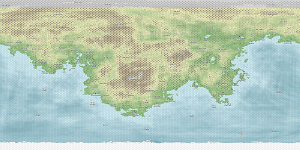
But that’s not why I choose this title. It’s because of the changes my ideas went through the last few years, which I wanna talk a bit for now. It’s been nearly 8 years ago that I started thinking about creating a new setting called Tetheril which was basically it’s own demiplane shut off from the rest of the multiverse by certain events that brought it into existence. I’m somewhat vague here because I still plan to use this idea, which originated in my dislike for planar travel ( I love the D&D planes for all they add to the game, but hate to see heroes trying to conquer Hell or the Abyss just because they are high level enough). Nothing much came out of this, because real life took a wrong turn and I had other problems to solve first.

Two years later, Paizo piqued my interest in hexploring with its Kingmaker Adventure Path, and I started thinking about using this to introduce players to my setting when I finally had enough material together. I also had read a cool Image comic called Impaler about the world being suddenly overrun by vampires and this together with some articles I had read in the online Dragon magazine and with what already had stewed a while in my head eventually was the source of what I tried to do with my setting:

What if a great cataclysmic catastrophe had destroyed the human lands, forcing the few survivors to seek refuge with the elves. And what if, in an coming age, tensions between humans and elves would lead the humans to leave their refuge and return to what was once their home? With no memories, only myths, of what had happened ages ago, so they had to rediscover what was once theirs?

So when I started last year’s edition of Johnn’s Adventure Design Workshop, I originally intended to have as my first adventure the landing of the humans at their new/old home and the events following. But this bit with the elves giving the humans shelter kept nagging at my mind and I thought it might be a cool idea to start with the events around the human’s departure from the elven shores instead. This way, the players would get a bit of perspective of the setting and of the motivations of their characters. Problem being that now I hadn’t only to think about a new continent for the PCs to explore but I had also to create the elven city they lived in before the exodus. Or at least so much that I could make play in this city interesting. Even then, I thought it a bit a waste of time to create a home base just to leave it as soon as possible (and I remember Pathfinder players being not to happy about getting such an interesting location as Sandpoint in Varisia is – only to take extended leaves during the rest of the AP). But the was the prize I did have to pay.

Or didn’t I?

Come this year, and here I am, picking up where I left and continuing my journey, already having rolled for my elven metropolis and still being not too crazy about having to built it from scratch. Maybe I should take some time with my PCs before them leaving for new lands, just to make the effort worth it? But what should I do with them? Not much to explore in a city humans have lived in for quite some time (around 5000 years, I thought), and I also didn’t want to do too much stuff which didn’t connect with the overarching themes of my setting. Building on the tensions between elves and humans? Might be a possibility, but wasn’t actually what I wanted to do, because I didn’t want to put the players‘ focus on that too much. Looked a bit like a dead end to me, and when that happens, I like to shift my attention somewhere else to give my subconsciousness time to work on the problem. And as I had nothing better to do, I took a look at the next video in line, in which Johnn talks a bit about the pre-planning stage of adventure design and about the concept of the “Razor”, a mechanism which allows the designer to make informed decisions about the inclusion of design elements based on certain themes the adventure is built upon. To give an example: When Paizo announced their new Starfinder setting (to come next year), “they described it as meeting half way between BattleTech and SpellJammer.“ Which already gives you an idea of what Starfinder will be about.

I started to ponder what my razor would be this year. I intended to let the players explore cool elven ruins, so Indiana Jones came directly into mind. Then I envisioned this elven city and the isle it is located on as kind of a prison; not as in a real prison but more as an enclave the human’s should not leave without the elves permission (maybe they even can’t without the elves help). But there was still the disconnect between the exploration I’d like the PCs to do and the fact that they already might have done that in the millenia past.

And then something clicked. I had already gone back in time once, so why not doing it again? If I went back to the time the humans arrived at this city, I could actually let them explore the city and make it their own. I could actually use all the stuff I had thought about in actual play instead of using it as background material. I could let them help developing the relations between elves and humans AND I could let them experience the prison-like character of the sub-setting they’re moving in (in time that is, I don’t expect that it will play as much a role in the beginning). So in the end, this is what I came up with as a razor (and man, how is that different, from what I had in mind during my first experiment with the workshop, the times are really a-changing):

The Ruins of Myth Drannor (elven city exploration and rebuilding)

meets

the Pathfinder Society (organized investigating and treasure-seeking)

meets

Gothic (the great CRPG, where you first have to settle in what’s basically a big prison and eventually will have to find a way out; and yeah, as in the game, there might be a BIG endboss waiting for you *whistles innocently*)

Keep in mind, though, that this is more the razor for this part of the setting. The adventure I try to develop for this workshop will mostly concentrate on the first aspect, I guess. So a sub-razor would be something like:

Bard’s Tale meets Kingmaker

combining the city exploration with the city rebuilding aspect .

Sales Madness at Open Gaming Store

MusingsFor all of you who like what Raging Swann Press and Dreamscarred Press have published over the years, there’s a real treat right over at the Open Gaming Store. Both Publishers have bundled several thousand pages of roleplaying awesomeness and until the end of October, you can be it for less then 30 $ per pack. Dreamscarred Press is known for its high quality Psionice material, which fills a niche Pathfinder obviously didn’t want to handle. This thing is even for those people who prefer the good old 3.5 over Pathfinder, because there’s the whole 3.5 back catalogue in it. And naturally there’s a lot of Pathfinder stuff too.

Raging Swann Press is dedicated to providing a lot of GM-friendly material which is generic enough to be easily used in every kind of campaign, but also stuffed with awesome ideas to spark whole adventures. Totally worth its price if you ask me.


[Review]Rite Publishing’s 10 Kingdom Seeds: Hills

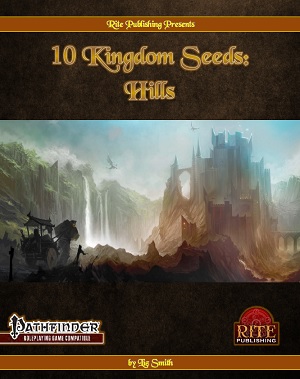
rp_tksh_coverThis is something which I should have posted a year ago. I was actually kinda surprised to find out that I hadn’t. SO without further ado:


Rite Publishing Presents 10 Kingdom Seeds: Hills by Liz Smith is part of a series providing the GM with short town descriptions she can easily plug-in into her game. These settlements are intended to be used as PC bases, as foundation stones to use with Pathfinder’s Kingdom Building Rules, but can as easily just be inserted into your setting, to fill empty regions between your big cities. And while they are written with hill terrain in mind, most of them aren’t so specific that they couldn’t be used with other terrain types as well.

The PDF consists of 9 pages, with 6 pages filled with actual content (plus cover, credits and OGL). Layout and page design is on a professional, high-level standard and I especially dig the artwork which would be worthy of any major publisher. Actual content are around half-page long descriptions of 10 settlements, ranging from Thorps to Villages. Each entry starts with the rule description (as seen first in Paizo’s Gamemastering Guide), followed by a short description of the look and the economy of each town. The last one being something I especially like as this is often the main reason why a settlement is founded at all and it immediately creates imaginery. One thing I also like is that those settlements are very varied as far as their main inhabitants‘ race is concerned. A chaotic good thorp inhabited by half-orcs can excellently serve to play with the player’s expectations (and if you’d rather have humans there, just change it, it’s no big deal)

Each entry also describes one or two important locations and concludes with some rumors about the settlement or its inhabitants which, while they sometimes feel like created with a random generator (which must not be a bad thing), still immediately add potential plot hooks and ideas to develop own adventures. I mean what could happen if a caravan with a holy sword comes to a village ruled by a CE cleric? (just to give an example). Here you find a village ruled by a bronze dragon, you have ghosts in the streets, cats stealing magic items (for what reason ever) or simply wandering hamlets made out of wheeled huts. So what this products really is successful at is to spark imagination without losing many words. The GM will have to work, if she wants to use these ideas, but she’ll have something to start with.

There are some things I have to criticize for honesty’s sake. The main criticism is directed at the rules section of each entry. As it seems, the designer forgot to include the modifiers from Table: Settlement Statistics into the settlement modifiers of each entry. There is also one major layout error in the Seahollow entry where the rules section has been divided by the text description. Minor mistakes (at least I think it wasn’t done intentionally) can be found in the rules sections for Starrywyn (Danger modifier should be -5 instead of +5) and Redhurst (being a thorp but using the magic item line for villages in the Marketplace section). I’m not the big rules guy, so this is nothing to put much importance in (maybe there are even reasons why there are so many items flowing around in Redhurst and why danger is higher in seemingly peaceful Starrywyn?) but if you’re using the settlement modifiers in actual play, you should be aware that you have to recalculate the modifiers according to the rules.

This all said, I can recommend this product. If you are building your own setting or if you’re using published settings, there will be empty places to fill and to do so, this product can be immensely helpful. This may not be obvious by the first look, but if you’re taking the time to really read the entries, you’ll find little, creativity sparking ideas helping you to really bring those settlements to live. So I’ll give it 4 out of five stars (a half star removed for the rules inconsistencies, another half star because some of the rumors seem a bit to random for my taste), because while not perfect, I’ll probably use all ten settlements in my homebrew (meaning that each of these settlements is worth way more than the 15 cents it costs, and that doesn’t even count in the splendid illustrations)

And so it began…

Musings„If it exists in D&D, then it has a place in Eberron!“

This bold statement was the start of it all. Part of the „Ten Things you need to know“ (in the Introduction of the Eberron Campaign Setting) totally got my attention. That a setting with such a different tone from the normal kitchen-sink D&D fantasy setting could still claim to be kitchen sink was something I’d never thought possible beforehand and made me rethink what I actually wanted to do with setting design. Now given the sheer masses of material written for any edition of the game, it seems physically impossible to do this, but at least this idea made me rethink my former policy of disallowing a lot of stuff which didn’t seem to fit into any given setting.

In the meantime, I’m all about allowing stuff, but under one condition: You have to be willing to modify the fluff to fit into the setting we chose to play (for example there are no Warforged in the Pathfinder Setting of Golarion, but with just a bit of rewriting, we surely could find a way to import them).

This is also the way I tend to read role-playing material from whatever source: How can I make it fit into my setting. So let’s that make RULE ONE for the design of Tetheril (the name of my world):

1. If it exists in Pathfinder, then it has a place in Tetheril!

And just to be clear: I do not intend to restrict myself to Paizo material only. But given that PFRPG is the engine that drives my game , this should be a minimum requirement. So I’ll give you rule 1.1

1.1. If it exists in the OGL universe, then it most probably has a place in Tetheril too.

And as if that wouldn’t be already overwhelming enough:

1.2. Without outright stealing, taking inspiration from D&D 1-5 or even other RPGs is explicitly allowed.

There are other rules I strive to follow:

2. The setting will be created through adventures first, through a campaign book second.

This is something that was originally the idea behind the Pathfinder Adventure Paths. Not to develop the setting through a lot of setting books but through the actual adventures written for Golarion. This policy has changed a bit in the meantime, and might also change for my setting someday, but at the moment, I hope that it will keep me from doing stuff that is not really useful at the moment. By the way, if I’m saying „book“, you’d better take this metaphorically. Maybe this will someday end in a publishable form, but that’s a long way to go, if I can go it at all.

3. Preference for low- to mid-level game.

I’m a big Eberron fan and what I think the setting did really well was to give a lot to play for characters between level 1-12. There were high-level dangers which would later be expanded upon, but at it’s core it wasn’t written with lower level characters in mind. I’ll try to take the same approach. Start small, but with the possibility to expand.

4. Low-magic approach

This is a bit tricky, so let me try to explain. One idea behind my setting is that magic has become scarce for some reason I’m not willing to share yet. There’s still magic there but mostly in the form of low-level magic. And (at least in the beginning) magic will even be more restricted for the player characters though that is something which will hopefully gradually change over time. So given what I said regarding point 3, I’m not sure if this will restrict player characters too much or at all, but if you expect the same magic level and magic wealth of the Realms, Golarion or other high-magic settings, you might get disappointed. This might also involve heavy tinkering with the rules and at least a bit nerfing of the Tier 1 and 2 classes.

5. Alignment isn’t what you think it is

This is also something I liked about Eberron, how it played with the alignment system (and thereby with the players‘ expectations). So I hope that I can create a setting where alignment isn’t something absolute but more of a gray area. And there might even come surprises in the form of inter-alignment alliances. So if you can’t handle Paladins working together with „evil“ persons, this setting might not be for you. There will be fight, there will be conflicts, but whose side you might find yourself fighting on has not necessarily to do with alignment

6. Culture and Race might define class choice

Well, in the beginning there won’t be many races to chose from because it will mostly center on humanity and there’s a lot of exploring to do. What I mean about that is that I will try to make cultural and racial choices of class and other options so appealing that players don’t necessarily look for the mechanically best option. There will be no hard restrictions, but setting-side it should be very clear that dwarves cannot take levels in the dragonrider class, because only elves have learned to tame those beasts and they don’t share the secret (just an example, which will most probably have nothing to do with my setting). So at least at my table, if a player comes up with this great idea for a dwarven dragonrider, he’d better have a good background explanation for how this came to be. Because, quite frankly, while I understand why official settings tend to be as nonrestrictive as possible, I don’t think that it necessarily makes for a good setting, if anything goes. Luckily, the Pathfinder archetype system gives me a lot to work with.

Well that’s it for today, but I wanted to get it out of my chest before I really start with working on my adventure.

Awoken from a long slumber

MusingsAn e-mail I got woke me from my slumber. It informed me of the fact, that Johnn Four’s Adventure Workshop (I already talked about that) goes into its next incarnation, meaning that Johnn rearranged the old videos and put them together in a new format accessible to new and old participants alike (I have no idea if it costs anything for newcomers, as a participant of the original workshop I had immediate access, then we paid a small fee I still consider to be well-spent money).

Well. That e-mail also reminded me of the fact that I had wasted to much time with not doing anything creative, so I’d just give it a new try, the blog as well as the workshop. And as I started it from anew, I came upon my first task, namely doing my First Move. This term describes the first step you take into the design process and Johnn suggests, you try to find something what works for you and start the process with excactly this thing everytime. For adventure writing, things that automatically come to mind are the heroes‘ home base or a map of the location the adventure plays in. Could also be the adventure’s villain or anything which gets your creative juice flowing (which is what the First Move actually is supposed to do).

Now in my case this is a bit more complicated, because I don’t only intend to write an adventure, but also to design the setting in which this adventure plays. This setting is based on a lot of ideas I had in the last 15 to 20 years that I never got penned down on paper. And some of the ideas may require tinkering with the system (or, to be honest, rewrite it in a way that fits my vision) but I’ll leave that aside for now. Which means that I’ll probably start with a more generic version of the adventure and change it later according to my needs.

At first I just wanted to tackle the ideas I had through the first workshop. Without going into too much detail, the adventure was planned to start in a city which would only serve as location for this single module (I already planned for a bigger campaign arc which would mostly play at another continent). In the meantime, I think that would have actually been a waste of opportunity to explore said city and thereby explore one of the base premises of my whole setting. So I decided just to stay in this city for a while. Meaning that my First Move would be to think about this city with the intension to flesh it out at a later time.

And while I already had some ideas of my own, I still like to add a random aspect to my creations to challenge myself thinking in new directions, so I decided to roll the dice to create a Stat Block for my city using the Pathfinder settlement rules from Pathfinder’s Game Mastery Guide. Just to have more material, I added stuff from a thread in the Paizo forums which made it into Nairbs Settlement Creator. I did the same with Otherverse Games‘ “Cityscapes – New Settlement Options for the Pathfinder Roleplaying Game”. And then I let the dice decide.

Here’s what I came up with for a start:

Settlement Type: Metropolis

Population: 67315

Alignment: Lawful Good

Government: Council

Qualities: Defensible, Eldritch, Good Roads, Pocket Universe, Unaging, Hardened

Next time, I’ll tell you a bit what I intend to do with this stats and how it fits into my larger vision of my setting.

[Review]Weekly Wonders – Villainous Archetypes Vol. II

WW-VA IIVillainous Archetypes: Vol. II is the latest entry in Necromancers of the Northwest’s Weekly Wonders series. As you may guess from the title, it’s about archetypes usable for evil characters, but is equally usable for GMs to create evil NPCs. It’s an 8-page PDF with 4 pages of actual content (the rest is front and back cover, credits and license stuff) which contains 5 archetypes.
The first one being the Brutal Oppressor, a barbarian archetype. With this one, you get to Swap Trap sense against Bully, which gives you a real nice use out of your Intimidate class skill. Which you can further improve with the Gory Display rage power which gives you an additional bonus on Intimidate with each successful critical hit. The other rage powers presented are Grab by the throat, which is more useful for the grappling barbarian, and Stay Down, which gives you an increasing damage bonus against prone opponents. And then there’s Bloodlust, a class ability replacing Tireless Rage, which potentially increases the number of rounds the barbarian can rage per day.

The second is the Elemental Defiler, a nice nod to the Dark Sun defiler of old and an archetype for the Kineticist. This archetype replaces Internal Buffer by Drain Energy, ability that basically does the same but is a bit more versatile, because you can use it, when you need it, and that you don’t need to accept burn to fill your buffer. On the other hand, you must use the won energy directly in the same round and the action provokes AoOs. And at Level 19, Drain Creature replaces Metakinetic Master and allows you to ignore burn according to the points of Constitution damage your opponent suffers.

The Extortioner is an Investigator archetype prone to blackmail his victims with the secrets he finds out. The Extortioner gets the Secret Finder class ability which improves and expands his trapfinding skill while losing his 3rd level investigator talent. Guilt Sense us a quite intriguing class ability which replaces boring trap sense. At the start, the extortioner gets a bonus on Sense Motive checks. At higher levels he also can cast detect thoughts as a spell-like ability, and even later on, he can force his victims to spill out secrets they are ashamed about. At fourth level, the extortioner replaces his swift alchemy class ability with Lingering Threat which improves upon the use of his Intimitade skill.

It seems as if the designers of this archetype felt it being a bit too strong, though, so they added Stunted Inspiration, which subtracts 1 point of Inspiration from the Extortioners inspiration pool. Seems more of a cosmetic change because in standard games, he might not really need all those inspiration points anyway.

The next one is the Villainous Bloodline for the sorcerer. Without going too much in detail, I generally like the conceptual idea, though the mechanics make it too easy to use it with actually good aligned characters. Ok, to inflict damage while simultaneously healing yourself (as the first level bloodline power Draining Touch allows) may not sound very goodish. And to paralyze your opponents and use them for protection (Hostage Taker at level 15) may also not be a sign for a true hero (though the problem is with the protection part and you don’t need to do this). On the other hand, neither Getaway (which allows you to escape via dimension door from narrow situations) nor the capstone ability Master of Deception are particularly evil in design and might come in handy for good-aligned characters as well.

And then there’s Villaneous Defenses, which might be much more powerful when used by good-aligned characters than by true villains. Reason being that you get DR/good, which might not be as efficient for a villain against a heroic group of adventurers, but can really help the Hero when fighting evil opponents.

This all said: you surely can use this with evil characters (especially when used in adventures where the opponents might even more evil), so it doesn’t actually goes against the designers‘ promise.

Last but not least, we have the Eldritch Slavemaster. This Summoner archetype forces his Eidolon(s) into his service rather than building a link to them. Which may have consequences in case he loses control over the summoned eidolon according to Conjurer’s Leash the replacement of 1st level’s Life Link. As this ability also comes with some restrictions regarding the distance allowed between summoner and eidolon, the designers added Slavedriver, an ability that let’s the eidolon cause more damage with successful hits, but also causes damage to the eidolon itself. At 4th level Shield Ally is replaced by Slave Shield. This ability lets the summoner decrease any hit point damage he suffers, but causes the eidolon to suffer twice the damage that its‘ slavemaster avoids. At 12th Level, Greater Slave Shield decreases the damage the Eidolon suffers this way. At 14th level, Drain Summoned Monster (self-explaining) replaces Life Bond and at 16th level, Explosive Summons replaces Merge Forms and allows the Summoner to use his summoned monsters as living bombs. And at level 20, Slave Army replaces Twin Eidolon and allows the slavemaster tohave summoned monsters and eidolon simultaneously, He can even have more than one summon monster or Gate spell active.

Summary: From 4 out of 5, the only archetype I would consider to be outright evil is the Eldritch Slavemaster. The other 4 can be surely used by evil, but also by non-evil characters. I mention this because I’m on of those GMs who normally not allows evil characters at his table but would probably allow those archetypes when set into the fitting context. But that’s not the important part. The important part is that you can create great evil PCs with them, and you can also use them to create interesting NPCs for your PCs to oppose. So the product does what it says, and it is doing it (in my opinion) without arising balance issues. I also didn’t stumble about glaring editorial issues. Meaning that I didn’t find anything which lets me substract points from the end note (maybe a half star for my issues with the Villainous bloodline sorcerer, but that I’d be inclined to round up).

So, 5 stars out of 5 it is.

My d6 New Year’s resolutions

MusingsNormally I’m not the type for New Year’s resolutions because I’ve experienced more than one time that I couldn’t keep them for what reasons ever (mostly because I got diverted by other goals). So, one week after New Year’s eve, I’m a bit surprised how this year those resolutions seem to pile up. In fact, I have to stop myself from inventing new ones just while writing this blog entry (quite unsuccessfully, to be honest, as this post started with an ‚d3‘ in the title :D).

In no particular order, those resolutions are:

1. losing some weight

2. writing one rpg-related review per week (at least 1 review of an Pathfinder 3pp product per month)

3. reading at least 1 book per week

4. writing at least one adventure with the ideas from John Fours Adventure Building Workshop

5. running an adventure as PbP (or over Roll20.net)

6. improving my guitar play

I probably should make this seven as I also want to work on my homebrew setting but as this may go hand-in-hand with the adventure writing process, I’ll subsume it under point 4.

At the moment I’m most confident about improving my guitar skill as I’m practicing nearly every day for at least half an hour. To read one book per week could get harder as it sounds, especially as some of the review items could be of the bigger sort and I don‘ t intend to cheat by counting them as read books. Reviewing one item per week shouldn’t be too hard though, as there are also shorter 3pp products waiting to be reviewed.

The other 3 resolutions I’m most concerned about. Generally I don’t find writing too hard. Nonetheless I keep finding excuses not to (and if it is writing blog posts about why I’m not writing an adventure, a short story or a novel instead), so this is definitely something which has to change, no matter how content (or discontent) I’ll be with the finished work.

And then there’s losing weight…

But just to keep book:

First finished review this Year: Rite Publishings 10 Kingdom Seeds: Hills (see next blog entry)

Currently reading: Dave Gross – Prince of Wolves

Written Words for my setting/adventure: 750

weight lost: None 😀

Motivating Monsters – The Giant toxic sponge

I hope that this will be the first in a series of articles taking a monster as inspiration for adventure and/or encounter creation. Monsters are one of the things D&D made me most exited about and to this day, I have problems to ignore monster books no matter the system they are written for. So there are already a lot of critters out there waiting for me to mull over them.

toxic-spongeOut of curiosity (once again), I picked up Octopus Games‘ Free Monster of November 2015, the Giant toxic sponge. This CR 5 monster lives at the bottom of the sea and is surprisingly mobile for a sponge. Main abilities are Siphon, with which the sponge creates a current drawing its prey towards itself and Swallow Whole (up two two creatures). Its Toxic Aura causes acid damage and may poison its prey. As long as you’re interested in underwater adventuring, it’s actually a nice little critter and the only thing I’d probably change is the poison-induced ability damage (from DEX to STR; the Save against the Siphon ability is strength-based so it would make sense to me if the Toxic Aura would attack the same ability, making the monster a little bit nastier .

And as this is what I’m most interested in (thinking about how to use the stuff I’m reading about), here are some ideas how to use the Giant toxic sponge.

1. The PCs are tasked to retrieve some treasure from a ship sunk before the coast during a heavy storm. Unluckily, the ship’s body has been infested by a pair of Giant toxic sponges feeding from the fauna living near the wrack. They won’t surely mind greater prey (like some meaty PCs for example who will literally have to go through the sponges to get what they came for.

2. When some townspeople go missing and the local authorities aren’t able to find any clues about their whereabouts, the PCs are hired to solve this riddle by the brother of a wealthy merchant who hasn’t been seen for several days. Hints point to a nearby lake and the PCs may find that the missed persons fell prey to a giant advanced toxic sponge. How did a salt water creature get into a sweet-water lake. And how is it able to survive there? The answers to these questions may lead to a mass murderer on the loose thinking he had found a way to commit the perfect crime.

3. For mysterious reasons a portal to the water plane opened in a big mountain cave looming over a little town. Poisonous Water pouring through the portal threatens to destroy the town but finding a way to close the portal involves exploring the cave. Meaning to handle the creatures coming through the portal as well as handling the portal itself which seems to be a gigantic living creature drawing the water out of the plane of water onto the material plane.